NEWS
STIMULATE presents its research at the iMRI Symposium in Boston
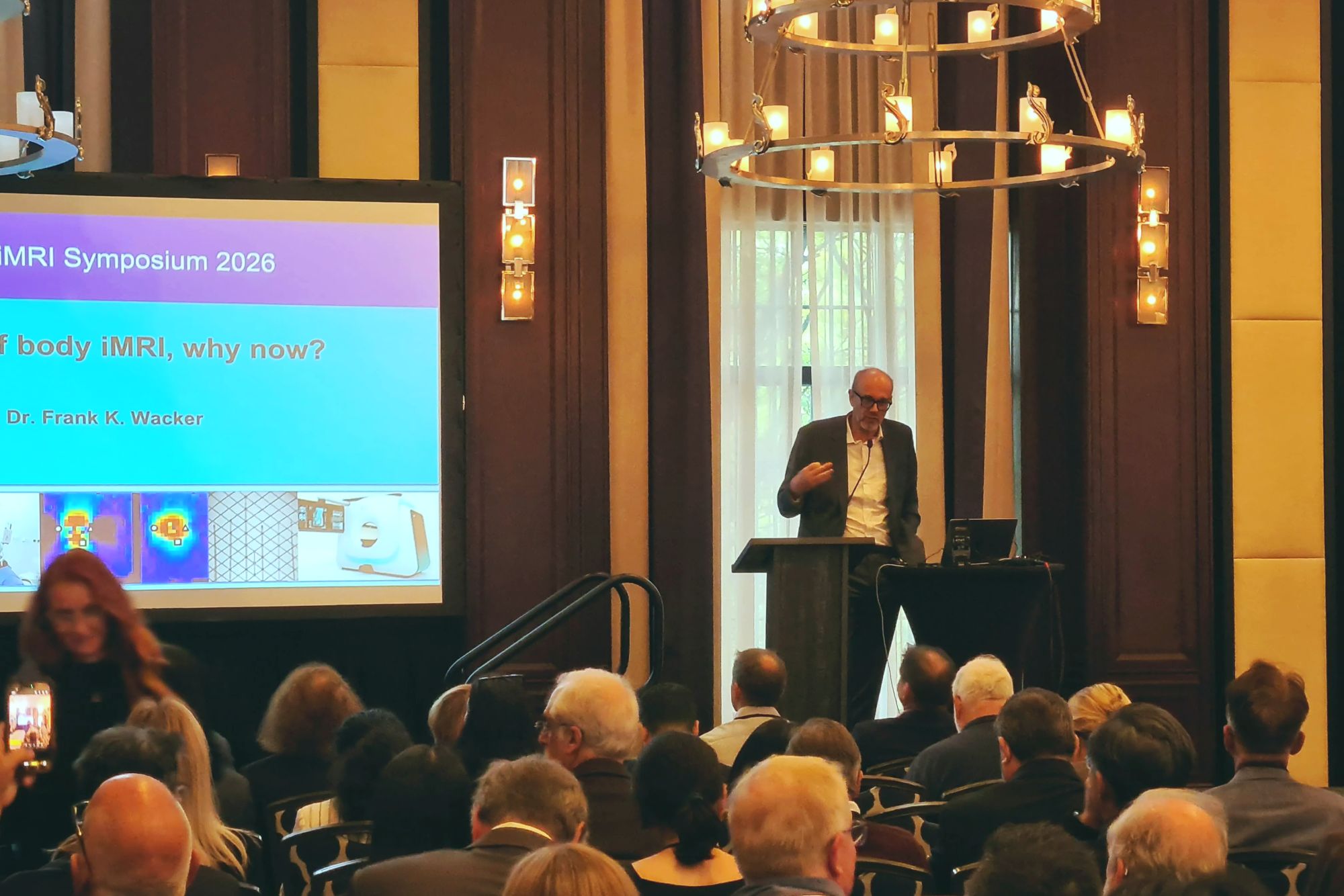
How can MRI-guided medical procedures be made more precise and safer? Several presentations from the Research Campus STIMULATE addressed this question at the 15th Interventional MRI (iMRI) Symposium on 8 and 9 October 2026 in Boston, USA.
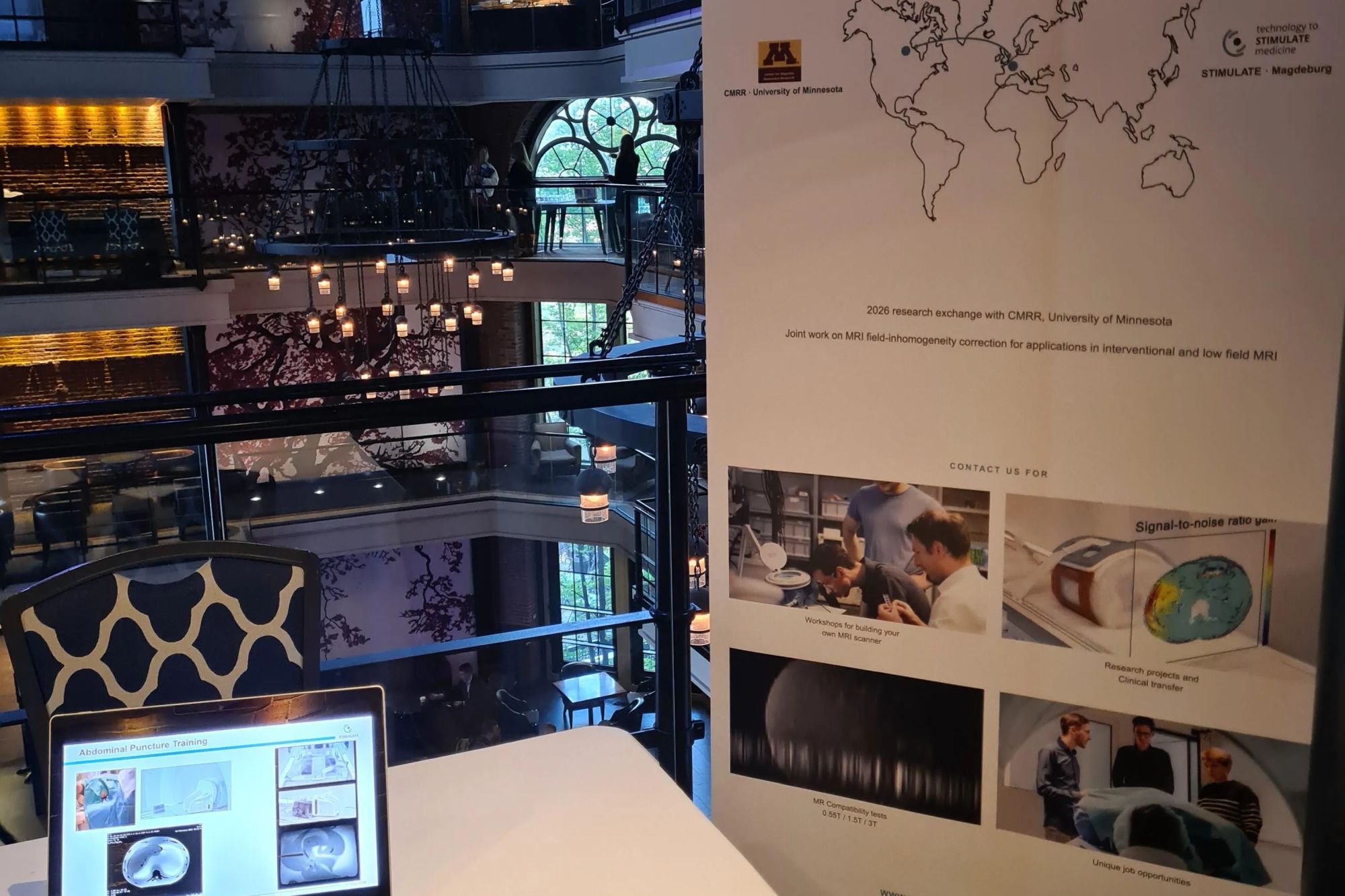
The international symposium brings together experts from the fields of medicine, engineering and imaging to discuss new developments relating to the use of magnetic resonance imaging in minimally invasive procedures. STIMULATE contributed to the scientific programme with several poster presentations and specialist talks, and took the opportunity to showcase its own research at a STIMULATE exhibition stand. This provided a space to engage in discussion with international participants, present research approaches and forge new contacts.
The research topics presented by the STIMULATE participants ranged from instrument tracking to artificial intelligence. Several posters focused on reliably localising medical instruments during MRI-guided procedures and evaluating new tracking methods. Other studies investigated temperature measurement using MRI, including for monitoring thermal treatments such as microwave ablation of liver tumours. The reliability of technical MRI data and an MRI-compatible holder for treatment instruments were also key areas of focus. Another paper presented an approach in which large language models and multiple AI agents analyse spoken information from workflows in interventional radiology. In the long term, such methods could help to better understand and optimise clinical processes.
The articles showcase the breadth of research at the STIMULATE Campus – all with the shared aim of further developing image-guided procedures and bringing technical innovations closer to clinical application.
Poster presentations
- Design and Preliminary Evaluation of an MR-Compatible Microwave Applicator Holder with Motion-Adaptive Compliance for Interventional MRI Procedures – Qiaozhi Chen (OVGU)
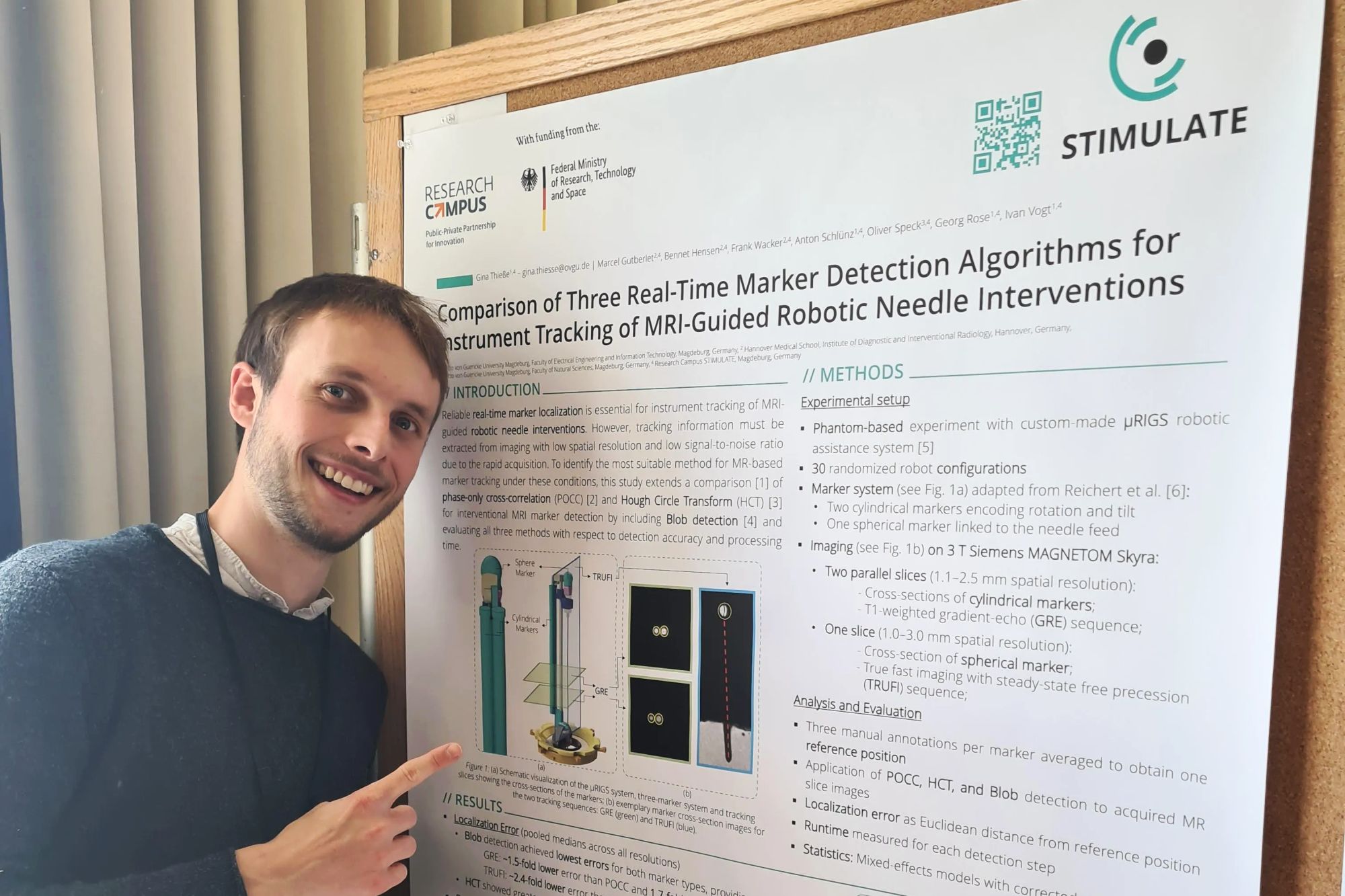
- Comparison of Three Real-Time Marker Detection Algorithms for Instrument Tracking of MRI-Guided Robotic Needle Interventions – Gina Thieße (OVGU)
- Automated Ground-Truth Generation for Markerless Stereo RGB Needle Tracking in MRI-Guided Prostate Biopsy – Nadeem Shah (OVGU)
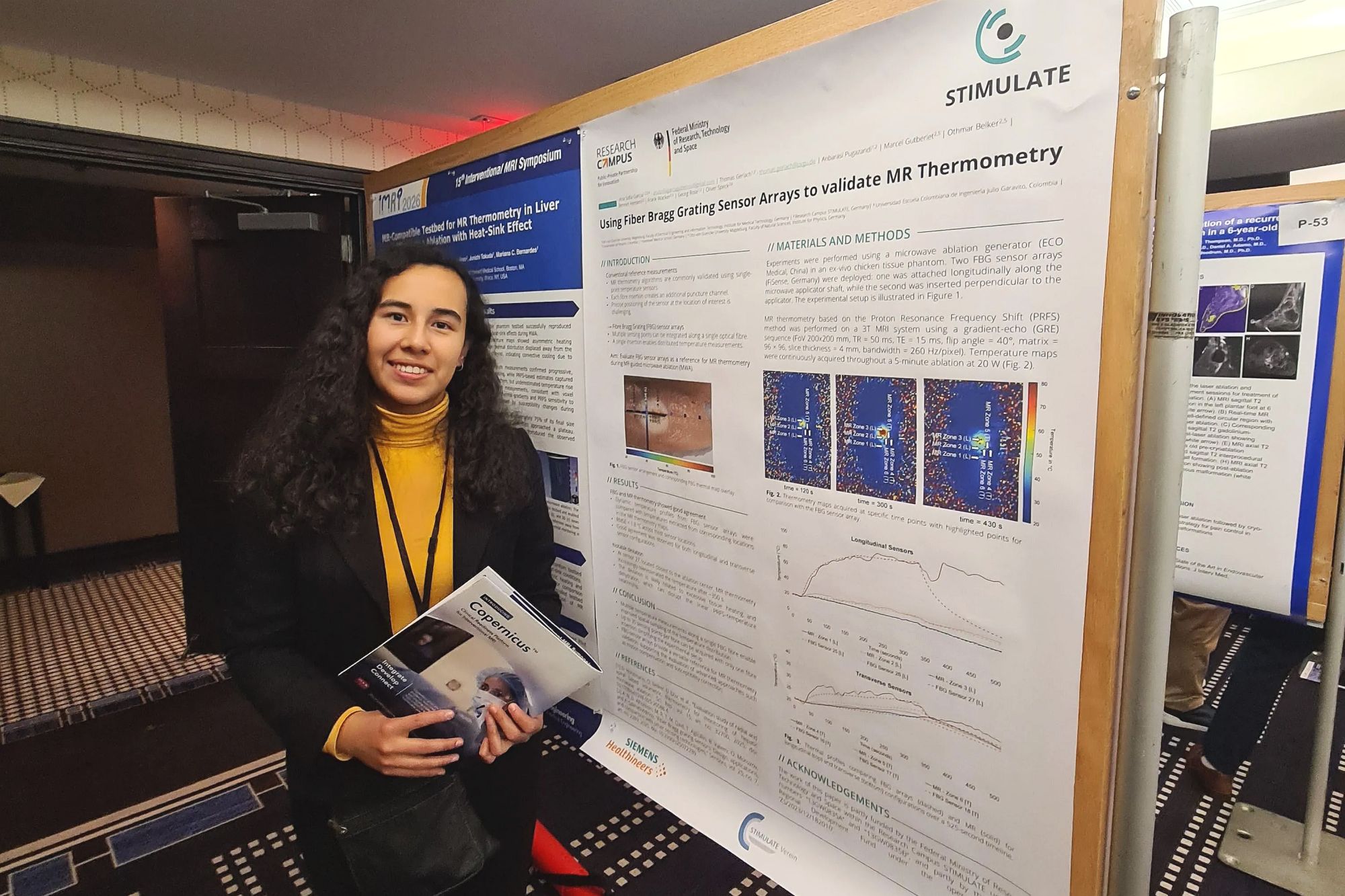
- Using Fiber Bragg Grating Sensor Arrays to Validate MR Thermometry – Ana Sofia Garcia
- Reliability of Vendor-Provided Gradient Data for Interventional Off-Center MR Imaging – Janis Seibt (OVGU)
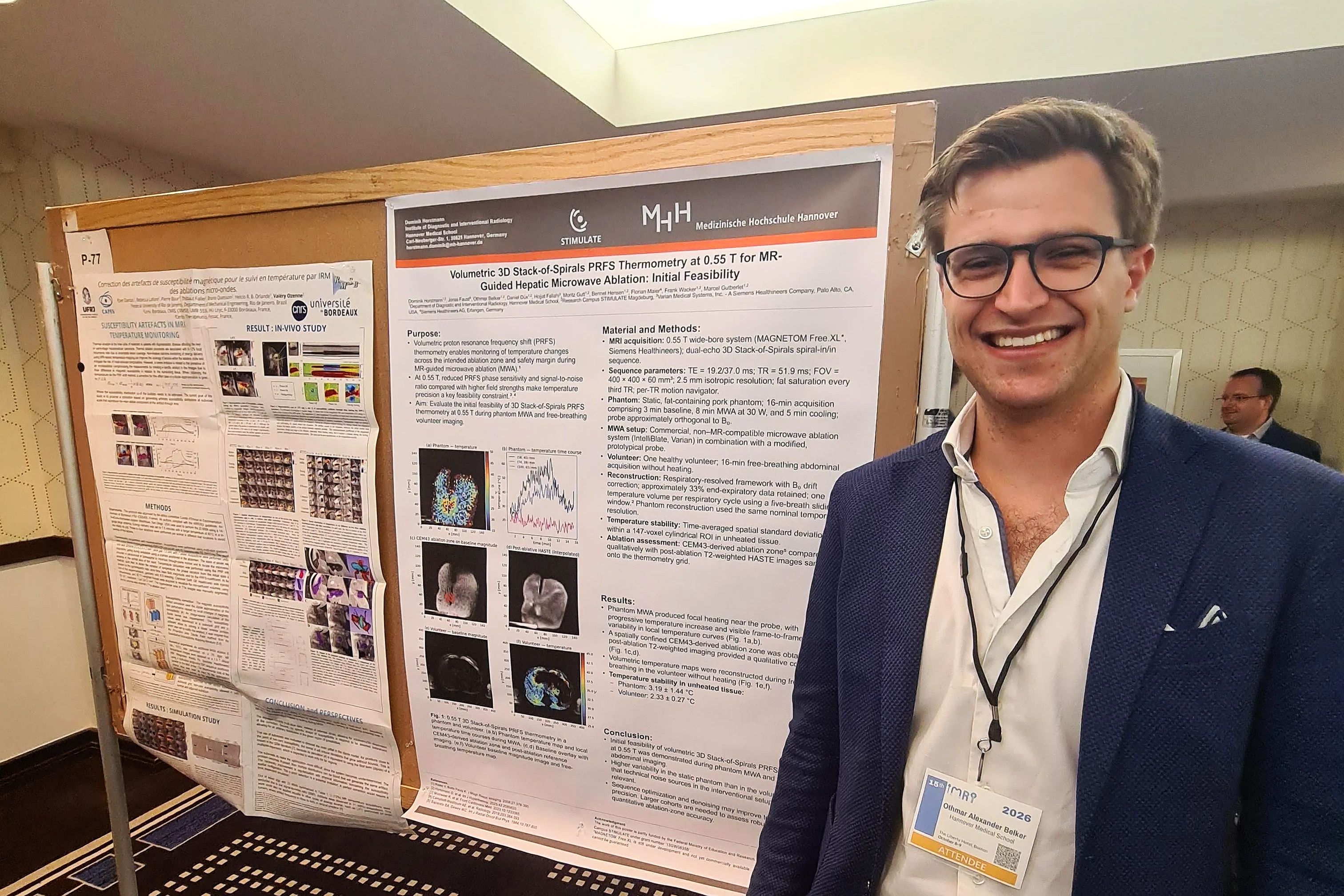
- Volumetric 3D Stack-of-Spirals PRFS Thermometry at 0.55 T for MR-Guided Hepatic Microwave Ablation: Initial Feasibility – Dominik Horstmann (MHH)
- Large Language Model-Supported Multi-Agent Pipeline for Speech-Based Workflow Analysis in Interventional Radiology: A Proof-of-Concept Study – Hui Chen (MHH)
Expert presentations
- Invited Talk: A New Era of Body iMRI, Why Now? – Prof. Frank Wacker (MHH)
- Assessing the Technical Feasibility of MR-Guided Irreversible Electroporation in a Porcine In Vivo Model in a 1.5T Clinical MR Environment – Othmar Belker (MHH)
- MRI Hybrid Ablation: Using the MR Scanner Hardware as Power Source for RF Ablation and as Receiving Unit of Thermal Monitoring by MR Thermometry – Thomas Gerlach (OVGU)
STIMULATE präsentiert Forschung beim iMRI Symposium in Boston
Wie lassen sich MRT-geführte medizinische Eingriffe präziser und sicherer gestalten? Mit dieser Frage beschäftigten sich mehrere Beiträge aus dem Forschungscampus STIMULATE beim 15. Interventional MRI (iMRI) Symposium am 8. und 9. Oktober 2026 in Boston, USA.
Das internationale Symposium bringt Fachleute aus Medizin, Ingenieurwissenschaften und Bildgebung zusammen, um neue Entwicklungen rund um den Einsatz der Magnetresonanztomographie bei minimal-invasiven Eingriffen zu diskutieren. STIMULATE beteiligte sich mit mehreren Posterpräsentationen und Fachvorträgen am wissenschaftlichen Programm und nutzte die Gelegenheit, die eigene Forschung an einem STIMULATE-Stand vorzustellen. Dieser bot Raum, um mit internationalen Teilnehmenden ins Gespräch zu kommen, Forschungsansätze zu präsentieren und neue Kontakte zu knüpfen.
Die von den STIMULATE-Beteiligten präsentierten Forschungsthemen reichten von der Instrumentenverfolgung bis hin zu künstlicher Intelligenz. Mehrere Poster beschäftigten sich damit, medizinische Instrumente während MRT-geführter Eingriffe zuverlässig zu lokalisieren und neue Tracking-Verfahren zu überprüfen. Weitere Arbeiten untersuchten die Temperaturmessung mittels MRT, unter anderem zur Überwachung von Wärmebehandlungen wie der Mikrowellenablation von Lebertumoren. Auch die Zuverlässigkeit technischer MRT-Daten und eine MRT-kompatible Halterung für Behandlungsinstrumente standen im Fokus. Ein weiterer Beitrag stellte einen Ansatz vor, bei dem große Sprachmodelle und mehrere KI-Agenten gesprochene Informationen aus Arbeitsabläufen in der interventionellen Radiologie analysieren. Langfristig könnten solche Verfahren helfen, klinische Prozesse besser zu verstehen und zu optimieren.
Die Beiträge zeigen die Bandbreite der Forschung am STIMULATE-Campus – mit dem gemeinsamen Ziel, bildgeführte Eingriffe weiterzuentwickeln und technische Innovationen näher an die klinische Anwendung zu bringen.
Posterpräsentationen
- Design and Preliminary Evaluation of an MR-Compatible Microwave Applicator Holder with Motion-Adaptive Compliance for Interventional MRI Procedures – Qiaozhi Chen (OVGU)
- Comparison of Three Real-Time Marker Detection Algorithms for Instrument Tracking of MRI-Guided Robotic Needle Interventions – Gina Thieße (OVGU)
- Automated Ground-Truth Generation for Markerless Stereo RGB Needle Tracking in MRI-Guided Prostate Biopsy – Nadeem Shah (OVGU)
- Using Fiber Bragg Grating Sensor Arrays to Validate MR Thermometry – Ana Sofia Garcia
- Reliability of Vendor-Provided Gradient Data for Interventional Off-Center MR Imaging – Janis Seibt (OVGU)
- Volumetric 3D Stack-of-Spirals PRFS Thermometry at 0.55 T for MR-Guided Hepatic Microwave Ablation: Initial Feasibility – Dominik Horstmann (MHH)
- Large Language Model-Supported Multi-Agent Pipeline for Speech-Based Workflow Analysis in Interventional Radiology: A Proof-of-Concept Study – Hui Chen (MHH)
Fachvorträge
- Invited Talk: A New Era of Body iMRI, Why Now? – Prof. Frank Wacker (MHH)
- Assessing the Technical Feasibility of MR-Guided Irreversible Electroporation in a Porcine In Vivo Model in a 1.5T Clinical MR Environment – Othmar Belker (MHH)
- MRI Hybrid Ablation: Using the MR Scanner Hardware as Power Source for RF Ablation and as Receiving Unit of Thermal Monitoring by MR Thermometry – Thomas Gerlach (OVGU)