NEWS
From a school internship to medical technology: How Philip Girschik found his way to STIMULATE
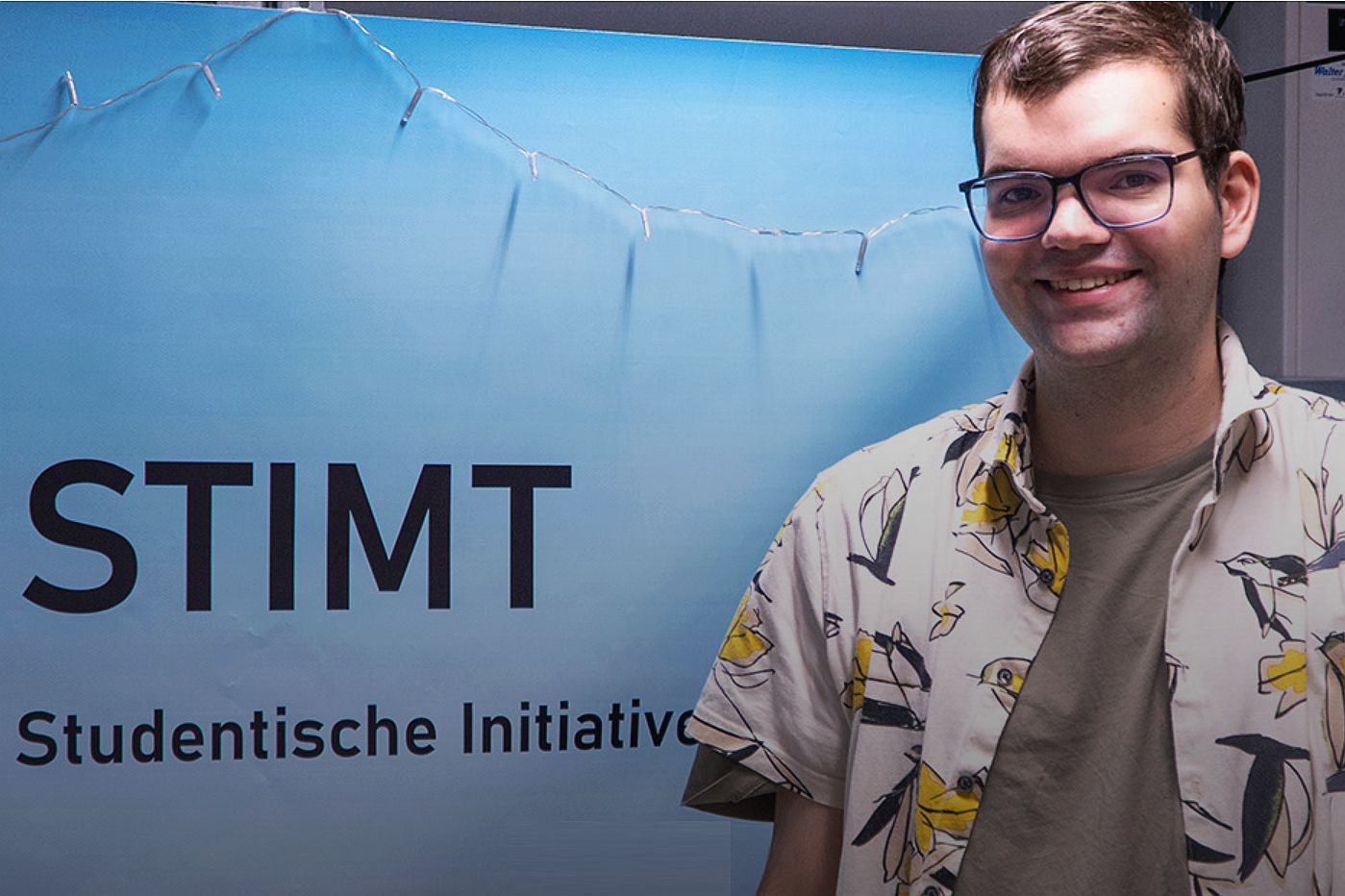
A school internship at the Research Campus STIMULATE sparked Philip’s enthusiasm for medical technology. Today, the 20-year-old is studying at the OVGU, is actively involved in the Student Initiative for Medical Technology (STIMT) and works as a student assistant at the Research Campus.
A newspaper article he read in Year 9 gave Philip Girschik the idea of studying medical technology. The article introduced the then-new Research Campus STIMULATE at the Wissenschaftshafen. ‘The pictures of the medical equipment immediately caught my attention,’ he recalls. As he already enjoyed experimenting with electronics in his spare time, he promptly asked if he could do a voluntary work placement during the summer holidays. For three weeks, Philip gained an insight into the research carried out on campus: he assisted with measurements for a bachelor’s thesis, worked with the 3D printer and even produced an MRI scan of a pepper. After that, he was certain: ‘I want to study medical technology later on.’
Combining medicine, technology and computer science: Philip is currently in his fifth semester of the Bachelor’s degree programme in Medical Technology at Otto von Guericke University Magdeburg. The programme combines engineering, computer science and medicine. Students learn how technical devices, procedures and software are used in the diagnosis, treatment and monitoring of diseases.
Research at the STIMULATE Campus also bridges this gap between medicine and technology. The focus is on minimally invasive, image-guided therapies, in which techniques such as MRI, CT and the visualisation of blood vessels help to navigate medical instruments precisely within the body. Philip particularly remembers the ‘Introduction to Medical Technology’ module. In the accompanying lecture series, doctors, start-up founders and researchers spoke about their day-to-day professional lives. ‘That was when I first realised just how diverse this degree programme is.’
Putting theory into practice: In the first few semesters, the timetable includes foundation courses in mathematics, physics, electrical engineering and computer science, as well as medical subjects. The theoretical component should not be underestimated, says Philip. Seminars and practical sessions provide variety, allowing students to apply their knowledge in the laboratory and, for example, carry out measurement experiments using EMG and ECG.
He particularly values project-based modules such as ‘Advanced Medical Engineering’, in which students carry out their own research projects. In the ‘Medical Innovations’ module, they also develop a medical device using a microcontroller. For the exam period, Philip recommends a study plan with specific goals. He says that those who study consistently and work through practice exercises can save themselves a lot of stress in the run-up to exams.
Right at the heart of research on the STIMULATE Campus: his connection to STIMULATE has continued even after his school work placement: alongside his studies, Philip works as a student assistant in the research campus’s IT department. He acts as a liaison with the university’s computing centre, procures hardware and sets up workstations. Roles like these offer students the opportunity to gain early insights into day-to-day research life and to explore their own interests in greater depth. ‘Many teachers draw attention to vacant research positions in their lectures,’ reports Philip.
Outside of his work, he is also involved in medical technology: he sits on the board of the Student Initiative for Medical Technology (STIMT). There, students from different years and disciplines develop their own projects. Their most recent project was a bionic prosthesis, and a mini MRI scanner is planned next. New members are welcome at any time.
The next step: medical imaging and his own research ideas: After completing his Bachelor’s degree, Philip would like to go on to do a Master’s in Medical Systems Engineering at OVGU. He can also envisage doing a PhD at STIMULATE. In terms of subject matter, he is particularly interested in medical imaging. He would like to do an industry placement with one of the start-ups on the research campus. His advice to prospective students: ‘Don't be afraid of university. It’s hard work, but make the most of the opportunities on offer.’
For Philip, Magdeburg is the perfect place to combine his interests: modern medical technology research, practical project work and the opportunity to put his own ideas into practice. His journey shows how an initial insight into life at the Research Campus can serve as a starting point for a degree course and involvement in research.
Vom Schülerpraktikum zur Medizintechnik: Wie Philip Girschik seinen Weg zu STIMULATE fand
Ein Schülerpraktikum am Forschungscampus STIMULATE weckte Philips Begeisterung für die Medizintechnik. Heute studiert der 20-Jährige an der OVGU, engagiert sich in der Studentischen Initiative Medizintechnik (STIMT) und arbeitet als studentische Hilfskraft am Forschungscampus.
Ein Zeitungsartikel in der 9. Klasse brachte Philip Girschik auf die Idee, Medizintechnik zu studieren. Der Artikel stellte den damals neuen Forschungscampus STIMULATE am Wissenschaftshafen vor. „Die Bilder von den medizinischen Geräten sprachen mich sofort an“, erinnert er sich. Da er schon in seiner Freizeit gern mit Elektronik experimentierte, fragte er kurzerhand nach einem freiwilligen Praktikum in den Sommerferien. Drei Wochen lang erhielt Philip Einblicke in die Forschung am Campus: Er unterstützte Messungen für eine Bachelorarbeit, arbeitete mit dem 3D-Drucker und fertigte sogar einen MRT-Scan einer Paprika an. Danach stand für ihn fest: „Ich möchte später Medizintechnik studieren.“
Medizin, Technik und Informatik verbinden: Heute ist Philip im fünften Semester des Bachelorstudiengangs Medizintechnik an der Otto-von-Guericke-Universität Magdeburg. Der Studiengang verbindet Ingenieurwissenschaften, Informatik und Medizin. Studierende lernen, wie technische Geräte, Verfahren und Software bei der Diagnose, Behandlung und Überwachung von Krankheiten eingesetzt werden.
Auch die Forschung am STIMULATE-Campus schlägt diese Brücke zwischen Medizin und Technik. Im Mittelpunkt stehen schonende, bildgestützte Therapien, bei denen Verfahren wie MRT, CT und die Darstellung von Blutgefäßen helfen, medizinische Instrumente präzise im Körper zu navigieren. Besonders in Erinnerung geblieben ist Philip die „Einführung in die Medizintechnik“. In der begleitenden Ringvorlesung berichteten Ärztinnen und Ärzte, Start-up-Gründerinnen und -Gründer sowie Forschende aus ihrem Berufsalltag. „Da habe ich zum ersten Mal gemerkt, wie vielfältig dieser Studiengang ist.“
Theorie praktisch anwenden: In den ersten Semestern stehen Grundlagen in Mathematik, Physik, Elektrotechnik und Informatik sowie medizinische Fächer auf dem Stundenplan. Der Theorieanteil sei nicht zu unterschätzen, sagt Philip. Für Abwechslung sorgen Seminare und Praktika, in denen Studierende ihr Wissen im Labor anwenden und beispielsweise Messversuche mit EMG und EKG durchführen.
Besonders schätzt er projektorientierte Module wie „Advanced Medical Engineering“, in denen Studierende eigene Forschungsprojekte umsetzen. Im Modul „Medical Innovations“ entwickeln sie außerdem ein medizintechnisches Produkt mit einem Mikrocontroller. Für die Prüfungsphase empfiehlt Philip einen Lernplan mit konkreten Zielen. Wer kontinuierlich lernt und Übungsaufgaben bearbeitet, könne sich viel Stress vor den Klausuren ersparen.
Mittendrin in der Forschung am STIMULATE-Campus: Seine Verbindung zu STIMULATE ist auch nach dem Schülerpraktikum geblieben: Neben dem Studium arbeitet Philip als studentische Hilfskraft in der IT des Forschungscampus. Er fungiert als Schnittstelle zum Universitätsrechenzentrum, beschafft Hardware und richtet Arbeitsplätze ein. Solche Stellen bieten Studierenden die Möglichkeit, früh Einblicke in den Forschungsalltag zu gewinnen und eigene Interessen zu vertiefen. „Viele Lehrpersonen machen in ihren Veranstaltungen auf freie Stellen in der Forschung aufmerksam“, berichtet Philip.
Auch außerhalb seiner Arbeit engagiert er sich für die Medizintechnik: Er sitzt im Vorstand der Studentischen Initiative Medizintechnik (STIMT). Dort entwickeln Studierende verschiedener Semester und Fachrichtungen eigene Projekte. Zuletzt entstand eine bionische Prothese, als Nächstes ist ein Mini-MRT geplant. Neue Mitglieder sind jederzeit willkommen.
Der nächste Schritt: Bildgebung und eigene Forschungsideen: Nach dem Bachelor möchte Philip den Masterstudiengang Medical Systems Engineering an der OVGU anschließen. Auch eine Promotion bei STIMULATE kann er sich vorstellen. Inhaltlich interessiert er sich besonders für die medizinische Bildgebung. Ein Industriepraktikum würde er gern bei einem der Start-ups am Forschungscampus absolvieren. Sein Rat an Studieninteressierte: „Habt keine Angst vor dem Studium. Es ist anstrengend, aber nutzt die Möglichkeiten, die euch geboten werden.“
Für Philip ist Magdeburg der richtige Ort, um seine Interessen zu verbinden: moderne medizintechnische Forschung, praktische Projektarbeit und die Möglichkeit, eigene Ideen umzusetzen. Sein Weg zeigt, wie ein erster Einblick am Forschungscampus zum Ausgangspunkt für ein Studium und die Mitarbeit in der Forschung werden kann.