NEWS
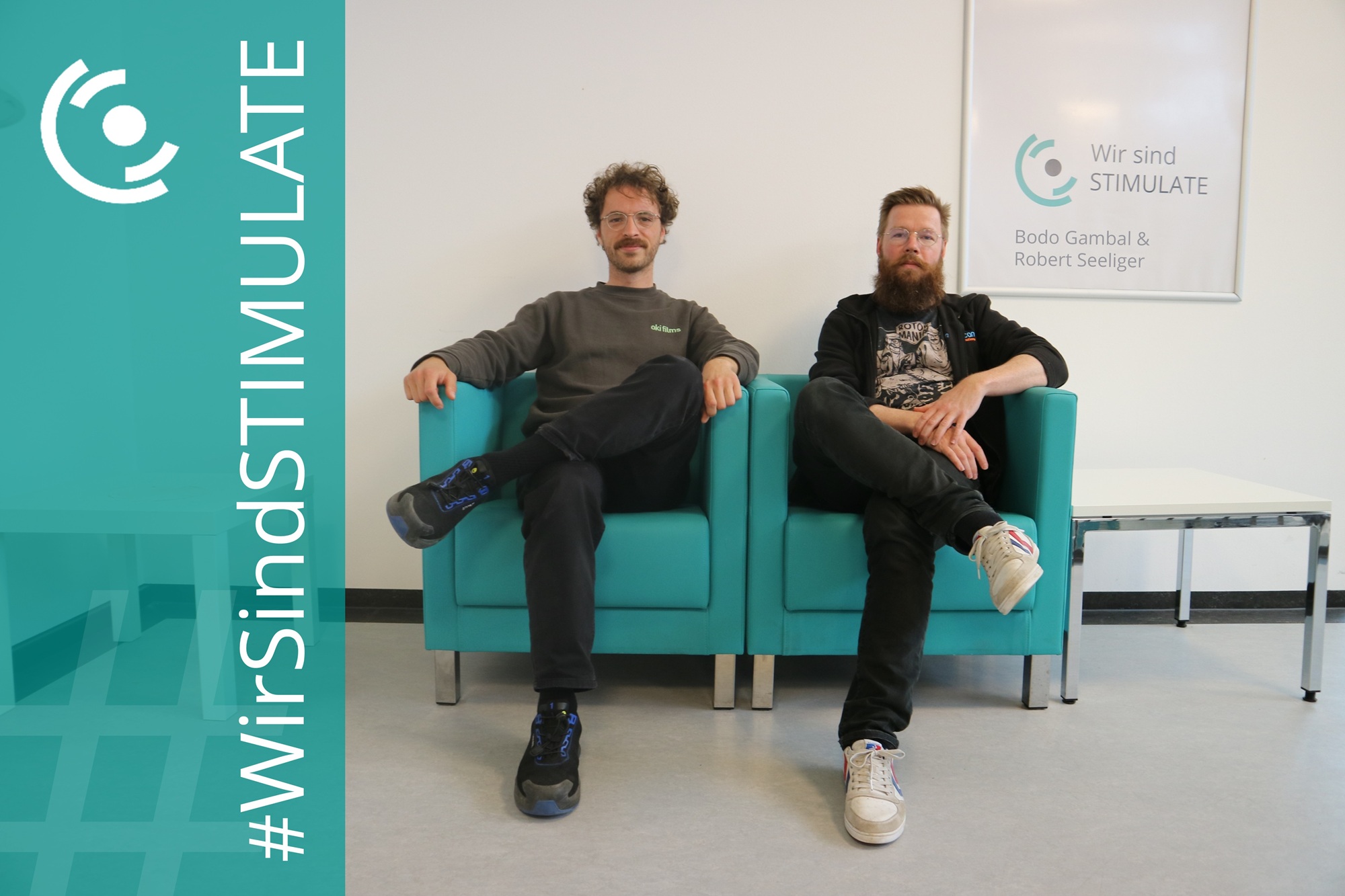
Interview ‘We are STIMULATE’ with Bodo Gambal & Robert Seeliger
Interviewee: Bodo Gambal and Robert Seeliger
Position: Hardware - Research and Development
Interviewer: René Schulte
Date: 06.05.2026
Hello Bodo, hello Robert, it’s great that you’ve taken the time for this interview today.
You’re both working on the joint research project between OVGU and Neoscan Solutions at the Research Campus STIMULATE, in the MRI hardware division. What appealed to each of you about the role, and how did you each end up there via different paths?
Bodo: I studied medical technology at OVGU and also worked as a student assistant in a research group at the Research Campus STIMULATE. This background made it easier to establish contact with STIMULATE partner Neoscan; the specialisation of my degree programme aligns very well with the areas of collaboration between OVGU and Neoscan. I am particularly interested in this field. Joining the company was a logical step for me.
Robert: I studied mechanical engineering in Magdeburg, completing a Diplom degree, and then spent eight years working for a company specialising in tool and specialised machine manufacturing. It was an educational and varied experience, but after those eight years I wanted to reorient myself professionally and gain experience in a different field. Through an acquaintance, I then learnt about the Research Campus STIMULATE and sent a speculative application. The project with Neoscan sounded very interesting, and the field of research and development in medical technology immediately appealed to me.
If you had to describe your current job in a few sentences: What exactly are you working on, and what are your respective areas of focus within the team?
Robert: My focus is primarily on design and development. As the project is still at an early stage of development, every component must be examined in detail – for example, in terms of forces, magnetic fields, materials, manufacturability and assembly, and the question of how these requirements can be reliably implemented from a technical perspective.
Bodo: My main areas of focus at the moment are the selection of materials and the electrical and mechanical simulation of components. I am also working on issues relating to magnetic shielding.
Robert, you have a background in mechanical engineering – Bodo, you have a background in medical technology. In what situations in your day-to-day work is it particularly evident how your different areas of expertise complement each other?
Bodo: Thanks to my degree in medical technology, I have a deeper understanding of the systems involved in MRI – that is, knowledge of the specific operating conditions, as well as the electrical engineering aspects.
Robert: I’d never had any experience with MRI before; it was a completely new field for me. Thanks to his degree, various courses and his work at STIMULATE, Bodo had a much deeper understanding of the subject right from the start. I myself come from a manufacturing background and bring mainly production experience to the table. I give a lot of thought to whether what we come up with in theory will actually work in the end, whether it can be assembled and whether it can be put into practice. This enables me to provide good support to the team.
What challenges do you face when developing hardware that is not only technically sound but also needs to be designed to be reliable and practical for use in a medical context?
Bodo: I would initially refer specifically to MRI scanners: naturally, MRI scanners have very specific requirements. In principle, absolutely every component, every screw and every cable must be designed in such a way that the device functions correctly and poses no risk to people. On top of that, there are specific conditions – such as temperature requirements – for which appropriate customised solutions must be found. At the same time, with MRI scanners, we are of course dealing with a product where standardisation and certain processes must be taken into account. An MRI scanner is, after all, a very specialised piece of equipment.
What advice would you give to young people who want to get into the field of medical hardware development?
Robert: Study, study, study (laughs). The theoretical foundations from your degree are, of course, important. In my view, practical experience is at least as crucial. That’s why I’d recommend gaining practical insights as early as possible through work placements, work-study programmes or part-time jobs. Because if you lack a basic understanding of how something actually works or where to find information, it’s difficult to develop something that will stand the test of time. The sooner you gain such experience, the better.
Bodo: I’d particularly recommend work placements, student assistant roles and projects. They give you the chance to try out a lot of different things and find out which area suits you best – for example, quality management, development or testing. These areas are closely interlinked, and it’s often only when you’re actually doing the work that you realise what suits you best.
Thank you very much for your time and for sharing these fascinating insights!
Click here for an overview of all interviews conducted so far.
Interview „Wir sind STIMULATE“ mit Bodo Gambal & Robert Seeliger
Interviewte: Bodo Gambal und Robert Seeliger
Stelle: Hardware - Research and Development
Interviewer: René Schulte
Datum: 06.05.2026
Hallo Bodo, hallo Robert, schön, dass ihr euch heute Zeit für dieses Interview genommen habt.
Ihr arbeitet beide im gemeinsamen Forschungsprojekt von der OVGU und Neoscan Solutions am Forschungscampus STIMULATE im MRT-Hardwarebereich. Was hat euch jeweils an der Aufgabe gereizt und wie seid ihr auf unterschiedlichen Wegen dort hingekommen?
Bodo: Ich habe Medizintechnik an der OVGU studiert und war außerdem als HIWI am Forschungscampus STIMULATE in einer Forschungsgruppe tätig. Über diesen Kontext war der Kontakt zum STIMULATE-Partner Neoscan vereinfacht, die Spezialisierung meines Studiengangs passen sehr gut zu den Kooperationsthemen zwischen OVGU und Neoscan. Dieser Bereich interessiert mich besonders stark. Der Einstieg war für mich ein logischer Schritt.
Robert: Ich habe in Magdeburg Maschinenbau auf Diplom studiert und anschließend zunächst acht Jahre in einem Unternehmen im Bereich Werkzeug- und Sondermaschinenbau gearbeitet. Das war lehr- und abwechslungsreich aber nach den acht Jahren wollte ich mich fachlich nochmal neu orientieren und in ein anderes Feld einarbeiten. Über einen Bekannten habe ich dann vom Forschungscampus STIMULATE erfahren und eine Initiativbewerbung geschrieben. Das Projekt mit Neoscan klang sehr interessant und der Bereich Forschung und Entwicklung in der Medizintechnik hat mich direkt überzeugt.
Wenn ihr eure jetzige Arbeit in wenigen Sätzen beschreiben müsstet: Woran arbeitet ihr konkret und wo liegen eure jeweiligen Schwerpunkte im Team?
Robert: Mein Fokus liegt vor allem auf der Konstruktion und Entwicklung. Da sich das Projekt noch in einer frühen Entwicklungsphase befindet, muss jedes Bauteil grundlegend betrachtet werden – etwa im Hinblick auf Kräfte, Magnetfelder, Materialien, Fertigbarkeit und Montierbarkeit und die Frage, wie sich diese Anforderungen technisch zuverlässig umsetzen lassen.
Bodo: Meine Schwerpunkte liegen derzeit vor allem in der Werkstoffauswahl sowie in der elektrischen und mechanischen Simulation von Bauteilen. Darüber hinaus arbeite ich auch an Fragestellungen rund um die magnetische Abschirmung.
Robert, du kommst aus dem Bereich Maschinenbau - Bodo, du kommst aus der Medizintechnik. In welchen Situationen zeigt sich im Arbeitsalltag besonders, wie sich eure unterschiedlichen Expertisen ergänzen?
Bodo: Durch mein Medizintechnikstudium bringe ich stärker das Systemwissen für das MRT mit, also Wissen über die besonderen Randbedingungen, aber auch über elektrotechnische Aspekte.
Robert: Ich hatte vorher noch keine Erfahrung mit MRT, das war für mich ein ganz neues Feld. Bodo war durch sein Studium, verschiedene Kurse und die Arbeit bei STIMULATE von Anfang an deutlich tiefer in der Materie drin. Ich selbst komme aus einem produzierenden Betrieb und bringe vor allem Erfahrung aus der Fertigung mit. Ich mache mir viele Gedanken darüber, ob das, was wir uns theoretisch überlegen, am Ende auch wirklich funktioniert, montierbar ist und sich praktisch umsetzen lässt. Damit kann ich das Kollegium gut unterstützen.
Welche Herausforderungen begegnen euch, wenn man Hardware nicht nur technisch entwickeln, sondern auch im medizinischen Kontext zuverlässig und anwendungsnah gestalten muss?
Bodo: Ich würde das zunächst speziell auf MRT beziehen: Für ein MRT hat man natürlich sehr besondere Anforderungen. Im Prinzip muss wirklich jedes Bauteil, jede Schraube und jedes Kabel so ausgelegt werden, dass das Gerät funktionsfähig ist und keine Menschen gefährdet. Dazu kommen spezielle Bedingungen, etwa Temperaturen, für die man entsprechende Sonderlösungen finden muss. Gleichzeitig haben wir es beim MRT natürlich auch mit einem Produkt zu tun, bei dem Standardisierung und bestimmte Prozesse mitgedacht werden müssen. Ein MRT ist eben ein sehr spezielles Gerät.
Was würdet ihr jungen Menschen raten, die in den Bereich der medizinischen Hardwareentwicklung einsteigen möchten?
Robert: Lernen, lernen, lernen (lacht). Die theoretischen Grundlagen aus dem Studium sind natürlich wichtig. Aus meiner Sicht ist Praxiserfahrung mindestens genauso entscheidend. Deshalb würde ich empfehlen, möglichst früh über Praktika, Werksstudium oder Nebenjobs praktische Einblicke zu sammeln. Denn wenn Grundlagen fehlen, wie etwas tatsächlich funktioniert bzw. wo man sich informieren kann, ist es schwer, etwas zu entwickeln, das später auch Substanz hat. Je früher man solche Erfahrungen sammelt, desto besser.
Bodo: Ich würde vor allem zu Praktika, Hiwi-Tätigkeiten und Projekten raten. Darüber kann man viel ausprobieren und herausfinden, welcher Bereich einem am meisten liegt – zum Beispiel Qualitätsmanagement, Entwicklung oder Testing. Diese Bereiche sind eng miteinander verzahnt und oft merkt man erst in der praktischen Arbeit, was am besten zu einem passt.
Vielen Dank für eure Zeit und die spannenden Einblicke!
Hier geht's zur Übersicht über alle bisher geführten Interviews.