NEWS
Science Insight: Imaging meets immunobiology – new precision diagnostics for cancer immunotherapy
The STIMULATE research group on Molecular Interventions and the Department of Molecular and Experimental Surgery at Magdeburg University Hospital are pooling their expertise in a joint research project. By combining medical imaging, computer-assisted analysis and molecular immunobiology, they aim to answer one of the key questions in modern oncology: Which patients actually benefit from immunotherapy – and why?
Immunotherapy has established itself as a treatment option in oncology and offers new hope for patients with gastrointestinal and other cancers. However, only a small proportion of those affected have benefited from these treatments so far; this makes it all the more important to be able to better predict who will actually benefit from immunotherapy. Medical imaging – particularly MRI and CT – remains indispensable for diagnosis in oncology. Building on imaging data, the team is developing a novel, patient-specific data layer that captures the immunological profile of individual tumours and links it to clinical image data using computer-aided analysis – with the aim of translating new research findings into clinical practice more quickly and making the diagnosis and treatment of cancers of the gastrointestinal tract more targeted and personalised.
A particular focus of the project is on tailoring treatments as precisely as possible to individual patients. To this end, the research team uses patient-derived organoids (PDOs) – small, mini-tumour models grown in the laboratory from tumour tissue, which replicate many of the characteristics of the original tumour. These models can be used to investigate, even before treatment begins, how the cancer might respond to immunotherapy. In addition, medical imaging data from clinical practice at Magdeburg University Hospital is analysed using modern computer-aided methods. The aim is to incorporate new findings into patient care more quickly and, in the long term, to contribute to more targeted and effective cancer treatment.
The project combines cutting-edge basic research with the analysis of real-world clinical data, thereby supporting the development of innovative research methods that minimise the use of animal testing. Initial scientific publications in renowned journals, as well as close collaboration with the Max Delbrück Centre for Molecular Medicine in Berlin, underscore the great potential of this research initiative.
Professors Roland S. Croner and Ulf D. Kahlert, together with the entire research team in the Department of Molecular and Experimental Surgery, are extremely grateful for the opportunity to contribute to this innovative and high-impact initiative – and look forward to the findings that this exceptional collaboration will continue to yield. This project is funded under the European Regional Development Fund (ERDF, (ZS/2023/12/182010)). Further scientific articles: Shi et al., eLife, 2025 · Yan et al., Frontiers in Immunology, 2025 · Peng et al., Discover Oncology, 2025.
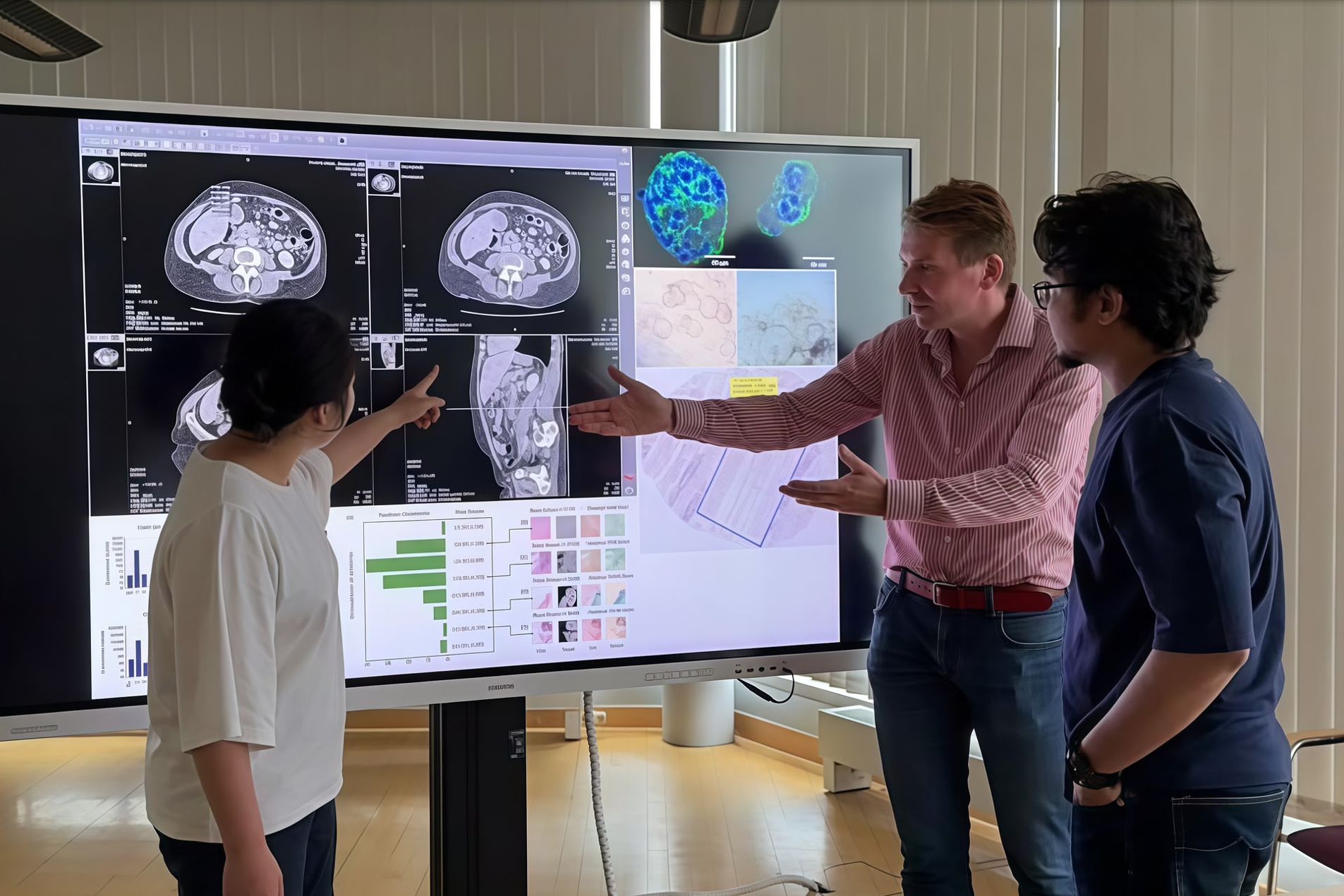
Picture: Workflows within the framework of the Immunoprofiling Project at the Department of Molecular and Experimental Surgery, Magdeburg University Hospital. Source: Department of Molecular and Experimental Surgery.
Bild: Arbeitsabläufe im Rahmen des Immunprofiling-Projekts der Molekularen und Experimentellen Chirurgie, Universitätsklinikum Magdeburg. Quelle: Molekulare und Experimentelle Chirurgie. /
Science Insight: Bildgebung trifft Immunbiologie – neue Präzisionsdiagnostik für die Krebsimmuntherapie
Die STIMULATE-Forschungsgruppe Molekulare Interventionen und die Abteilung für Molekulare und Experimentelle Chirurgie am Universitätsklinikum Magdeburg bündeln ihre Expertise in einem gemeinsamen Forschungsprojekt. Durch die Verbindung von medizinischer Bildgebung, computergestützter Analyse und molekularer Immunbiologie wollen sie eine der zentralen Fragen der modernen Onkologie beantworten: Welche Patient:innen profitieren tatsächlich von einer Immuntherapie – und warum?
Die Immuntherapie hat sich als Therapiemöglichkeit in der Onkologie etabliert und bietet neue Hoffnung für Patient:innen mit gastrointestinalen und anderen Krebserkrankungen. Dennoch profitiert bislang nur ein kleiner Teil der Betroffenen von diesen Therapien; umso wichtiger ist es, besser vorhersagen zu können, wer tatsächlich von einer Immuntherapie profitieren wird. Die medizinische Bildgebung – insbesondere MRT und CT – bleibt dabei ein unverzichtbar für die Diagnostik in der Onkologie. Aufbauend auf den bildgebenden Daten entwickelt das Team eine neuartige, patientenspezifische Datenschicht, die das immunologische Profil individueller Tumore erfasst und computergestützt mit klinischen Bilddaten verknüpft – mit dem Ziel, neue Forschungsergebnisse schneller in die klinische Praxis zu überführen und die Diagnose sowie Behandlung von Krebserkrankungen des Magen-Darm-Trakts gezielter und individueller zu gestalten.
Ein besonderer Schwerpunkt des Projekts liegt darauf, Therapien möglichst genau auf einzelne Patientinnen und Patienten abzustimmen. Dafür nutzt das Forschungsteam patientenabgeleitete Organoide (PDOs) – kleine, im Labor aus Tumorgewebe gezüchtete Mini-Tumormodelle, die viele Eigenschaften des ursprünglichen Tumors nachbilden. An diesen Modellen kann bereits vor einer Behandlung untersucht werden, wie der Krebs auf eine Immuntherapie reagieren könnte. Ergänzend werden medizinische Bilddaten aus der klinischen Versorgung am Universitätsklinikum Magdeburg mithilfe moderner computergestützter Verfahren ausgewertet. So sollen neue Erkenntnisse schneller in die Patientenversorgung einfließen und langfristig zu einer gezielteren und wirksameren Krebsbehandlung beitragen.
Das Projekt verbindet moderne Grundlagenforschung mit der Analyse realer klinischer Daten und unterstützt damit die Entwicklung innovativer, tierversuchsarmer Forschungsmethoden. Erste wissenschaftliche Veröffentlichungen in renommierten Fachzeitschriften sowie die enge Zusammenarbeit mit dem Max-Delbrück-Centrum für Molekulare Medizin in Berlin unterstreichen das große Potenzial dieser Forschungsinitiative.
Die Professoren Roland S. Croner und Ulf D. Kahlert sowie das gesamte Forschungsteam der Abteilung für Molekulare und Experimentelle Chirurgie sind außerordentlich dankbar für die Möglichkeit, zu dieser innovativen und wirkungsstarken Initiative beizutragen – und freuen sich auf die Erkenntnisse, die diese außergewöhnliche Kooperation weiterhin hervorbringen wird. Dieses Projekt wird im Rahmen des Europäischen Fonds für Regionale Entwicklung (EFRE, (ZS/2023/12/182010)) gefördert. Weiterer Fachbeitrag: Shi et al., eLife, 2025 · Yan et al. Frontiers in Immunology, 2025, Peng et al., Discover Oncology, 2025.