NEWS
Interview ‘We are STIMULATE’ with Madeleine Hertel
Interviewee: Madeleine Hertel
Position: Clinical Collaboration Manager
Interviewer: René Schulte
Date: 27.05.2026
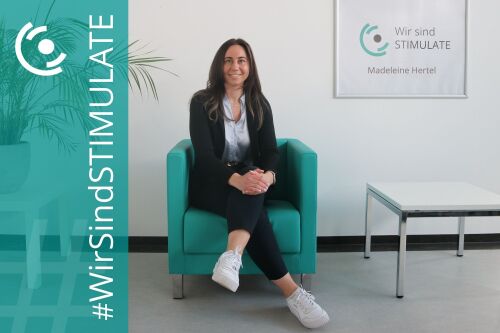
Hello Madeleine, first of all, congratulations on recently completing your PhD! It’s great that you’ve found the time to do this interview today.
You studied physics and specialised in experimental biophysics and nanophysics from an early stage. What was it about this subject that particularly fascinated you back then?
Reply: On the Bachelor’s degree in Physics, there aren’t actually that many opportunities to specialise properly; that really only comes into play at Master’s level. There, I was particularly drawn to applied physics with a medical focus. I realised that I’m particularly suited to topics where you don’t just work with theories, models or highly abstract questions, but where there’s a more direct link to real-world applications.
A key turning point for me was my Bachelor’s thesis on phase-contrast imaging. That was when I truly understood, for the first time, just how closely medical imaging is linked to the fundamentals of physics – from radiation absorption and detectors right through to image formation. That’s exactly what fascinated me and ultimately led me to consciously pursue my Master’s in this direction.
You worked at Siemens Healthineers whilst studying for your master’s degree. To what extent did this early practical experience help you in your subsequent career?
Reply: First of all, the role really helped me to see the theoretical knowledge I’d gained from my physics degree and from the field of imaging applied in the real world. In other words, to understand: what actually happens with this in practice? How are such images generated, how are they used with patients or in medicine, what are they used for, and what goes on behind the scenes in image processing?
I was able to gain many of these insights whilst working as a working student and later as a Master’s student. In particular, I learnt about the entire image processing chain, from acquisition right through to further processing. This was very helpful for my career path because it shaped the direction in which I realised: this is a field that really interests me and one in which I’d like to stay. In my view, working as a student trainee or undertaking an external Master’s thesis is precisely why these opportunities are so valuable: to find out for yourself whether a field is not only theoretically fascinating, but also a good long-term career fit.
You held various roles at Siemens Healthineers – from working as a Master’s student, through your PhD, to becoming a Clinical Collaboration Manager. What has particularly shaped your career path within the company, and what have you learnt along the way?
Reply: It was actually the people around me who had the greatest influence on me along this path. Throughout the various stages, I always had people around me who supported me and provided guidance from their respective roles. Even as a working student, I worked with PhD students and this gave me an initial impression of what a possible future path might look like. It was similar later on during my Master’s thesis: I was once again in an environment where I could see how a PhD works and what opportunities it can offer, both academically and professionally. As a result, the step towards doing a PhD was much less daunting for me.
One particularly important lesson I learnt during my PhD was that technical feasibility alone is not enough. It is not enough to show that something works on the device – you also have to validate it in clinical trials, that is, in collaboration with the people who will later be working with it, and with a focus on the benefits and safety for patients. It was precisely this realisation that had a major influence on my future career path and ultimately led me to specialise in Clinical Collaboration Management. Today, part of my job involves helping to design precisely these kinds of clinical trials, finding suitable partners and supporting their implementation.
As part of your PhD, you were also involved with the Research Campus STIMULATE and Otto von Guericke University Magdeburg. How did that come about, and what particularly appealed to you about working in that environment?
Reply: My path to the Research Campus STIMULATE and the OVGU came about as part of my PhD in industry. As I was working on multimodal imaging using X-rays and ultrasound at the time, it wasn’t easy at first to find a suitable academic supervisor. Through the close links between Siemens and STIMULATE, I was then put in touch with Professor Rose, who was able to provide excellent guidance on the topic thanks to his extensive experience in medical imaging.
What particularly appealed to me about this environment was the combination of research and practical application. I received a great deal of support there with specific methodological questions and, at the same time, saw how scientific findings could be further developed for practical application in collaboration with the university and the Research Campus.
You are active as a Student Advisor in the IEEE Ultrasonics, Ferroelectrics and Frequency Control Society. What exactly do your responsibilities involve in this role?
Reply: As a Student Advisor, I am a member of the executive committee of this technical society and, together with six student representatives, oversee the three specialist areas of Ultrasonics, Ferroelectrics and Frequency Control. My role is to support student activities at the respective specialist conferences, which involves helping to organise events, managing budgets, taking part in decision-making and representing the society at these events. The main aim is to connect students with experts from research and industry and to offer them suitable opportunities for exchange at the conferences, such as networking events or pitch competitions. At the same time, I am also the first point of contact when external parties wish to initiate joint initiatives with the students.
It is particularly important to me to open up opportunities for students that I myself was fortunate enough to experience in this role. I was a Student Representative from 2020 to 2021 and found this work to be very enriching – academically, organisationally and personally. It is precisely this experience that I now wish to pass on to the next generation.
When you look back on your journey so far: Which skills have been particularly important – and which ones would you recommend to others?
Reply: Looking back, three things in particular were crucial for me: communicating openly, persevering, and clearly articulating what you actually want. Many important steps along my journey didn’t come about because something just happened to come my way, but because I talked about them – with all sorts of different people, often in completely unexpected situations. That’s how contacts, opportunities and, ultimately, concrete possibilities arose. This has actually been a recurring theme throughout my entire journey: from my part-time student job, through my Master’s thesis, to my PhD and my current job. Time and again, I’ve actively shared what my next step should be, what I’m looking for and what interests me. Often, I didn’t get an immediate response, but eventually something did come up through various channels. That’s why my main advice to others would be: speak up about what interests you, ask actively and keep at it, even if you don’t get an immediate response. Networks often emerge precisely from conversations like these.
Thank you very much for your time and for the interesting insight.
Click here for an overview of all interviews conducted so far.
Interview „Wir sind STIMULATE“ mit Madeleine Hertel
Interviewte: Madeleine Hertel
Stelle: Clinical Collaboration Manager
Interviewer: René Schulte
Datum: 27.05.2026
Hallo Madeleine, erstmal herzlichen Glückwunsch zu dem kürzlichen Abschluss deiner Promotion! Schön, dass du heute Zeit hast, um dieses Interview zu machen.
Du hast Physik studiert und dich schon früh im Bereich Experimentalbiophysik und Nanophysik vertieft. Was hat dich damals an diesem Fach besonders fasziniert?
Antwort: Im Bachelor in Physik gibt es noch gar nicht so viele Möglichkeiten, sich wirklich zu spezialisieren; das kommt eigentlich erst im Master. Dort hat mich vor allem die angewandte Physik mit medizinischem Bezug angesprochen. Ich habe gemerkt, dass mir Themen besonders liegen, bei denen man nicht nur mit Theorien, Modellen oder sehr abstrakten Fragestellungen arbeitet, sondern einen direkteren Bezug zu realen Anwendungen hat.
Ein wichtiger Auslöser war für mich meine Bachelorarbeit zur Phasenkontrastbildgebung. Dabei habe ich zum ersten Mal wirklich verstanden, wie eng medizinische Bildgebung mit physikalischen Grundlagen verknüpft ist. Von Strahlenabsorption über Detektoren bis hin zur Bildentstehung. Genau das hat mich fasziniert und letztlich auch dazu geführt, meinen Master bewusst in diese Richtung weiterzuentwickeln.
Als Working and Master’s Student warst du bei Siemens Healthineers tätig. Inwiefern hat dir diese frühe praktische Erfahrung in deinem weiteren beruflichen Weg geholfen?
Antwort: Zunächst einmal hat mir die Tätigkeit sehr dabei geholfen, das theoretische Wissen aus dem Physikstudium und der Bildgebung überhaupt einmal in der Realität zu sehen. Also zu verstehen: Was passiert eigentlich damit in der Praxis? Wie werden solche Bilder erzeugt, wie kommen sie am Patienten beziehungsweise in der Medizin zum Einsatz, wofür werden sie gebraucht und was steckt in der Bildverarbeitung dahinter?
Viele dieser Einblicke konnte ich schon als Werkstudent und später dann auch als Masterandin mitnehmen. Vor allem die gesamte Bildverarbeitungskette von der Aufnahme bis zur weiteren Verarbeitung. Für meinen beruflichen Weg war das sehr hilfreich, weil es die Richtung geprägt hat, in der ich gemerkt habe: Das ist ein Bereich, der mich wirklich interessiert und in dem ich auch bleiben möchte. Genau dafür sind Werkstudententätigkeiten oder externe Masterarbeiten aus meiner Sicht sehr wertvoll: um für sich selbst herauszufinden, ob ein Bereich nicht nur theoretisch spannend ist, sondern auch langfristig beruflich passt.
Bei Siemens Healthineers warst du in unterschiedlichen Rollen tätig – vom Working Master’s Student über die Promotion bis hin zum Clinical Collaboration Manager. Was hat deinen Weg innerhalb des Unternehmens besonders geprägt/was hast du auf diesem Weg gelernt?
Antwort: Am stärksten geprägt hat mich auf diesem Weg tatsächlich mein Umfeld. Ich hatte in den verschiedenen Phasen immer Menschen um mich, die mich begleitet und mir aus ihren jeweiligen Rollen heraus Orientierung gegeben haben. Schon als Werkstudentin habe ich mit Doktoranden gearbeitet und dadurch einen ersten Eindruck bekommen, wie ein möglicher weiterer Weg aussehen könnte. Ähnlich war es später in der Masterarbeit: Ich war wieder in einem Umfeld, in dem ich sehen konnte, wie Promotion funktioniert und was fachlich und beruflich daraus entstehen kann. Dadurch hat mir der Schritt zur Promotion auch deutlich weniger Angst gemacht.
Ein besonders wichtiges Learning war für mich während der Promotion, dass technische Machbarkeit allein nicht ausreicht. Es reicht nicht zu zeigen, dass etwas am Gerät funktioniert – man muss es auch in klinischen Studien validieren, also gemeinsam mit den Menschen, die später damit arbeiten, und mit Blick auf den Nutzen und die Sicherheit für Patient:innen. Genau diese Erkenntnis hat meinen weiteren Weg stark beeinflusst und letztlich auch dazu geführt, dass ich mich in Richtung Clinical Collaboration Management entwickelt habe. Heute gehört es zu meinem Job, genau solche klinischen Studien mitzudenken, passende Partner zu finden und die Umsetzung zu begleiten.
Für deine Promotion warst du auch am Forschungscampus STIMULATE und an der Otto-von-Guericke-Universität Magdeburg eingebunden. Wie kam es dazu und was hat dich an der Arbeit in diesem Umfeld besonders gereizt?
Antwort: Der Weg an den Forschungscampus STIMULATE und zur OVGU ergab sich im Rahmen meiner Promotion in der Industrie. Da ich mich damals mit multimodaler Bildgebung aus Röntgen und Ultraschall beschäftigt habe, war es zunächst nicht einfach, eine passende wissenschaftliche Betreuung zu finden. Über die enge Verbindung zwischen Siemens und STIMULATE kam dann der Kontakt zu Professor Rose zustande, der das Thema mit seiner breiten Erfahrung in der medizinischen Bildgebung sehr gut begleiten konnte.
Besonders gereizt hat mich an diesem Umfeld die Verbindung aus Forschung und Anwendung. Ich habe dort viel Unterstützung bei konkreten methodischen Fragen bekommen und gleichzeitig erlebt, wie sich wissenschaftliche Ergebnisse gemeinsam mit Universität und Forschungscampus in Richtung Praxis weiterdenken lassen.
Du bist als Student Advisor in der IEEE Ultrasonics, Ferroelectrics und Frequency Control Society aktiv. Was genau gehört in dieser Rolle zu deinen Aufgaben?
Reply: Als Student Advisor bin ich Teil des Vorstands dieser technischen Gesellschaft und betreue gemeinsam mit sechs studentischen Vertreter:innen die drei Fachbereiche Ultrasonics, Ferroelectrics und Frequency Control. Meine Aufgabe ist es, studentische Aktivitäten auf den jeweiligen Fachkonferenzen zu begleiten, also Veranstaltungen mitzuplanen, Budgets zu steuern, Entscheidungen mit zutreffen und die Formate innerhalb der Gesellschaft zu vertreten. Dabei geht es vor allem darum, Studierende mit Fachleuten aus Forschung und Industrie zu vernetzen und ihnen auf den Konferenzen passende Austauschformate anzubieten: Etwa Networking-Events oder Pitch-Wettbewerbe. Gleichzeitig bin ich auch erste Ansprechperson, wenn von außen gemeinsame Initiativen mit den Studierenden angestoßen werden sollen.
Besonders wichtig ist mir dabei, Studierenden Möglichkeiten zu eröffnen, die ich selbst in dieser Rolle früher erleben durfte. Ich war von 2020 bis 2021 selbst Student Representative und habe diese Arbeit als sehr bereichernd erlebt – fachlich, organisatorisch und persönlich. Genau diese Erfahrung möchte ich nun an die nächste Generation weitergeben.
Wenn du auf deinen bisherigen Weg zurückblickst: Welche Fähigkeiten waren besonders wichtig – und welche würdest du anderen empfehlen?
Reply:Rückblickend waren für mich vor allem drei Dinge entscheidend: offen kommunizieren, dranbleiben und klar formulieren, was man eigentlich will. Viele wichtige Schritte in meinem Weg sind nicht entstanden, weil etwas zufällig zu mir kam, sondern weil ich darüber gesprochen habe - mit ganz unterschiedlichen Menschen, oft auch in völlig unerwarteten Situationen. So haben sich Kontakte, Chancen und schließlich konkrete Möglichkeiten ergeben. Das hat sich eigentlich durch meinen gesamten Weg gezogen: Von der Werkstudentenstelle über die Masterarbeit bis zur Promotion und meinem jetzigen Job. Ich habe immer wieder aktiv erzählt, was mein nächster Schritt sein soll, wonach ich suche und was mich interessiert. Oft kamen nicht sofort Rückmeldungen, aber irgendwann ergab sich über Ecken doch etwas. Deshalb würde ich anderen vor allem empfehlen: Sprecht aus, was euch interessiert, fragt aktiv nach und bleibt dran, auch wenn nicht sofort etwas zurückkommt. Netzwerke entstehen oft genau aus solchen Gesprächen.
Vielen Dank für deine Zeit und für den interessanten Einblick.
Hier geht's zur Übersicht über alle bisher geführten Interviews.