NEWS
Interview ‘We are STIMULATE’ with Matthias Buck
Interviewee: Matthias Buck
Position: Managing Director at BEC Medical GmbH
Interviewer: René Schulte
Date: 06.05.2026
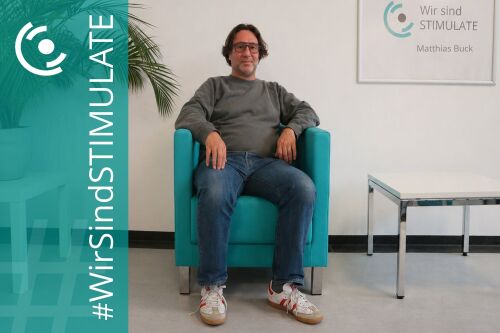
Hello Matthias, it’s great that we have the opportunity to do this interview today. I’m looking forward to hearing about your work.
Matthias, you’ve held a senior position at BEC for many years and have been CEO of BEC Medical GmbH since 2025. What initially shaped your career path towards robotics and medical technology?
Reply: My path into robotics and medical technology wasn’t a straightforward one: I originally trained as a joiner. However, I’ve always been fascinated by technology, and thanks to my father’s passion for automation technology – back then in the drinks industry – I came into contact with robotics at an early age.
Whilst studying industrial engineering in Pforzheim, I explored this field in greater depth – particularly in practical applications such as welding, handling systems and machine tools. That was my introduction to robotics; medical robotics came later.
For research and development projects, BEC collaborates with partners at the Research Campus M²OLIE and the Research Campus STIMULATE; you and BEC Medical also set up shop at the latter over a year ago. How did that come about, and what are the benefits of operating within a Research Campus environment as a relatively small company?
Reply: Our entry into this field stemmed from a close partnership with Magdeburg University Hospital, which led to our first contracts in the fields of AI and medical robotics. That was the spark that got us started. At the same time, collaboration with Research Campuses such as STIMULATE has been important to us for many years – we have been active members of the STIMULATE Association for several years now and have also carried out joint research projects.
For us as a small company, the major advantage lies in direct access to science, universities and, above all, the hospital. It is precisely this proximity between business, medicine and academia that is ideally provided here at STIMULATE.
Given your more than 20 years’ experience with robotic prototypes and products, which developments in medical robotics do you consider to be particularly significant?
Reply: The development of telemanipulators in surgery has been particularly influential for me. Even though, from a robotic perspective, these are not always ‘classic’ robots, these systems have played a key role in increasing the acceptance of robotics in medical technology. Their widespread use has demonstrated the tangible benefits such platforms offer to patients, surgeons and clinical staff. For me, they are therefore an important gateway to many developments that are yet to come in medical robotics.
You have been and continue to be involved in the development of patient positioning systems for radiotherapy. What challenges are particularly crucial in ensuring that such systems can be used safely in clinical practice?
Reply: In radiotherapy – as in all medical applications – patient safety is the top priority. At the same time, particularly high precision requirements are crucial here, especially in particle therapy.
A particular challenge lies in the wide variation in patient-specific loads acting on the system. As our robot is based on serial kinematics, it reacts sensitively to different load conditions. The system must therefore be designed to position patients – from children to the heaviest adults – stably, safely and with high accuracy. For me, this is precisely the key safety and performance feature of such systems in radiotherapy.
You have also been working for BEC as a director in the US since 2014. What differences have you noticed between the German and American markets?
Reply: The US market is generally much quicker and easier to break into than the German market. You often strike up a conversation very quickly and do business just as swiftly. The bigger challenge, however, lies in maintaining stable, close relationships over the long term. I find this more difficult in the US than in Germany – perhaps because there are more frequent changes in the people we deal with on the client side.
What would you have liked to have had as a guide when you first started out in robotics and medical technology? Do you have any advice for young people who want to follow a similar career path to yours?
Reply: Looking back, it’s hard to say. But what I would definitely encourage young people to embrace are curiosity and courage. In medical technology in particular, people often emphasise just how complex and demanding regulatory requirements are – and that’s certainly true. At the same time, however, there are always opportunities to find good solutions through creativity and innovative approaches, and even to turn these into competitive advantages.
A second important point is networks and connections. In my view, they are a key building block for personal and professional development.
Thank you very much, Matthias, for taking the time to do this interview!
Click here for an overview of all interviews conducted so far.
Interview „Wir sind STIMULATE“ mit Matthias Buck
Interviewter: Matthias Buck
Stelle: Geschäftsführer bei BEC Medical GmbH
Interviewer: René Schulte
Datum: 06.05.2026
Hallo Matthias, schön, dass wir heute die Gelegenheit zum Interview haben. Ich freue mich auf die Einblicke in eure Arbeit.
Matthias, du bist seit vielen Jahren in leitender Funktion bei BEC tätig und seit 2025 CEO der BEC Medical GmbH. Was hat deinen beruflichen Weg in Richtung Robotik und Medizintechnik ursprünglich geprägt?
Antwort: Mein Weg in die Robotik und Medizintechnik war nicht geradlinig: Ursprünglich habe ich zunächst eine Ausbildung zum Schreiner gemacht. Technik hat mich aber schon immer begeistert, und über die Leidenschaft meines Vaters für Automatisierungstechnik, damals in der Getränkeindustrie, bin ich früh mit Robotik in Berührung gekommen.
Im Studium des Wirtschaftsingenieurwesens in Pforzheim habe ich diesen Schwerpunkt weiter vertieft – vor allem in praktischen Anwendungen wie Schweißapplikationen, Handlingsystemen und Werkzeugmaschinen. Das war mein Einstieg in die Robotik, die Medizinrobotik kam dann erst später dazu.
Für Forschungs- und Entwicklungsprojekte arbeitet BEC zusammen mit Partnern im Forschungscampus M²OLIE und im Forschungscampus STIMULATE, bei letzterem habt ihr euch mit BEC Medical vor über einem Jahr auch angesiedelt. Wie kam es dazu und welche Vorteile hat es als eher kleines Unternehmen im Forschungscampus Umfeld zu agieren?
Antwort: Der Einstieg hier ergab sich aus einer engen Partnerschaft mit dem Universitätsklinikum Magdeburg, aus der sich erste Aufträge im Bereich KI und Medizinrobotik entwickelt haben. Das war für uns die Initialzündung. Gleichzeitig ist die Zusammenarbeit mit Forschungscampi wie STIMULATE für uns schon seit vielen Jahren wichtig – wir sind bereits seit mehreren Jahren im STIMULATE Verein aktiv und hatten auch schon gemeinsame Forschungsprojekte durchgeführt.
Für uns als kleines Unternehmen liegt der große Vorteil im direkten Zugang zu Wissenschaft, Hochschulen und vor allem zur Klinik. Genau diese Nähe zwischen Unternehmen, Medizin und Lehre ist hier in STIMULATE ideal gegeben.
Angesichts deiner über 20jährigen Erfahrung mit robotischen Prototypen und Produkten - Welche Entwicklungen in der medizinischen Robotik hältst du für besonders ausschlaggebend?
Antwort:Besonders prägend war für mich die Entwicklung von Telemanipulatoren in der Chirurgie. Auch wenn das aus robotischer Sicht nicht immer „klassische“ Roboter sind, haben diese Systeme wesentlich dazu beigetragen, die Akzeptanz von Robotik in der Medizintechnik zu steigern. Ihr breiter Einsatz hat gezeigt, welchen konkreten Nutzen solche Plattformen für Patient:innen, Operateur:innen und klinisches Personal bieten. Für mich sind sie damit ein wichtiger Türöffner für viele Entwicklungen, die in der medizinischen Robotik noch folgen werden.
Du warst und bist an der Entwicklung von Patientenpositioniersystemen für die Strahlentherapie beteiligt. Welche Herausforderungen sind dabei besonders entscheidend, damit solche Systeme später sicher in der Praxis eingesetzt werden können?
Antwort: In der Strahlentherapie steht – wie in allen medizinischen Anwendungen – die Patientensicherheit an erster Stelle. Gleichzeitig sind hier besonders hohe Präzisionsanforderungen entscheidend, gerade in der Partikeltherapie.
Eine besondere Herausforderung liegt in den sehr unterschiedlichen patientenspezifischen Lasten, die auf das System wirken. Da unser Roboter auf einer seriellen Kinematik basiert, reagiert er sensibel auf verschiedene Lastfälle. Deshalb muss das System so ausgelegt sein, dass es Patient:innen vom Kind bis zum schwersten Erwachsenen stabil, sicher und mit hoher Genauigkeit positionieren kann. Genau das ist für mich das zentrale Sicherheits- und Leistungsmerkmal solcher Systeme in der Strahlentherapie.
Seit 2014 bist du für BEC auch als Direktor in den USA tätig. Welche Unterschiede erlebst du zwischen dem deutschen und dem amerikanischen Markt?
Reply: Der US-Markt ist in der Geschäftsanbahnung meist deutlich schneller und einfacher als der deutsche. Man kommt oft sehr schnell ins Gespräch und auch zügig ins Geschäft. Die größere Herausforderung liegt allerdings darin, diese Beziehungen langfristig stabil und eng zu halten. Das erlebe ich in den USA schwieriger als in Deutschland – eventuell, weil es dort auf Kundenseite häufiger Wechsel bei den Ansprechpersonen gibt.
Was hättest du dir zu Beginn deines eigenen Weges in Robotik und Medizintechnik als Orientierungshilfe gewünscht? Hast du Tipps für junge Menschen, die einen ähnlichen Karriereweg einschlagen möchten wie du?
Reply:Rückblickend ist das schwer zu sagen. Was ich jungen Menschen aber auf jeden Fall mitgeben würde, sind Neugier und Mut. Gerade in der Medizintechnik wird oft betont, wie komplex und aufwendig Regulatorik ist – das stimmt auch, gleichzeitig gibt es aber immer Möglichkeiten, mit Kreativität und innovativen Ansätzen gute Lösungen zu finden und daraus sogar Wettbewerbsvorteile zu entwickeln.
Ein zweiter wichtiger Punkt sind Netzwerke und Verbindungen. Sie sind aus meiner Sicht ein zentraler Baustein für die persönliche und berufliche Entwicklung.
Vielen Dank, Matthias, dass du dir die Zeit für dieses Interview genommen hast!
Hier geht's zur Übersicht über alle bisher geführten Interviews.