NEWS
Interview ‘We are STIMULATE’ with Stefanie Feierabend
Interviewee: Stefanie Feierabend
Position: Research Associate
Interviewer: Felix Baumann
Date: 26.02.2026
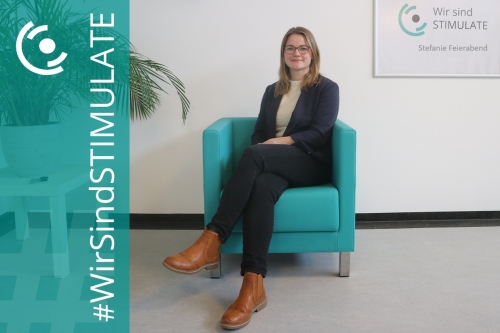
Hello Stefanie, thank you for taking the time to do this interview. You work as a research assistant in the ‘Neuro Clinic’ research group at the Research Campus. What is your current area of focus, and what makes the work here so special?
Reply: My work focuses on the development of highly precise, intricate vascular models – specifically of arteries and veins, including any pathological changes. To this end, I segment patient data, process it digitally and convert it into physical models that can be used for realistic applications. These are used in projects at the Neuroclinic as well as at Medical Flows. In this role, I act as an interface between the two research groups and work closely with both sides.
In addition, I provide technical support to students by creating models for their projects and setting up suitable experimental setups. Another focus is the further development of imaging in angiography.
What is particularly special for me is the direct link to the clinic: we work closely with Prof Dr Daniel Behme and Dr Roland Schwab and test our developments immediately in a real-world application context. This makes the concrete benefits for patients directly visible.
At the start of your career, you worked in the field of orthotics and prosthetics. What motivated you to go down this path, and how did you eventually end up at the Research Campus?
Reply: I came to the profession of orthopaedic technician through my own personal experience. Due to an illness I had during my growing years – which has since been fully treated – I was a patient myself for several years and wore a corset. At the time, the staff were exclusively men, which wasn’t always comfortable for me as a young female patient. That motivated me to take up this profession myself – partly with the aim of increasing the proportion of women and bringing more diversity to the trade as a whole.
I later became aware of the research campus through a Women’s Science Slam, at which Prof Dr Sylvia Saalfeld, among others, presented her work. I was particularly impressed by the combination of innovative research and practical application. I then took the initiative to apply to the Otto von Guericke University Magdeburg for the Research Campus STIMULATE and have been working here for two years.
What does a typical working day look like for you at the Research Campus?
Reply: There isn’t a set routine. A large part of my work takes place at the computer, where I segment medical image data, process it in Blender, add specific connections for fluid circuits to the models, and then produce them using SLA 3D printing.
In addition, I regularly liaise with project partners, assist with angiography procedures and carry out measurements. The technical implementation of student projects is also part of my daily routine.
The mix of digital development, practical implementation and direct clinical relevance makes my working day very varied.
Experience shows that not everything goes smoothly straight away when developing prototypes. How do you deal with setbacks, and what motivates you to keep going?
Reply: Setbacks are, of course, an integral part of development work. If something doesn’t work as planned, I see this as an important indication of where there is still room for improvement. For me, it is important to view these steps as part of an iterative process.
The great advantage here at the Research Campus is the supportive environment: if something doesn’t work as planned, we analyse the causes together and develop targeted improvements. It is particularly valuable to observe the future users directly as they work with the models in the angiography suite. This allows me to quickly identify where there is room for improvement – whether in the vascular structures, the connection options or the entire experimental setup.
This direct exchange and the opportunity to refine my designs immediately motivate me greatly to keep at it and improve solutions step by step.
To finish up, I’d be interested to know: what’s your biggest goal for the future?
Reply: Looking ahead, I would like to further develop my work with 3D-printed vascular models, with a view to potentially spinning off a new venture. The aim is to turn this into my own start-up. In doing so, I intend to make use of the support available, such as that offered by the Ego Incubator, to establish a successful spin-off. At the same time, I hope to continue working on exciting projects that will help me grow both professionally and personally.
Well then, I wish you every success with the spin-off and the development of the start-up, and thank you very much for the lovely chat.
Click here for an overview of all interviews conducted so far.
Interview „Wir sind STIMULATE“ mit Stefanie Feierabend
Interviewte: Stefanie Feierabend
Stelle: Wissenschaftliche Mitarbeiterin
Interviewer: Felix Baumann
Datum: 26.02.2026
Hallo Stefanie, schön, dass du dir Zeit für unser Interview nimmst. Du wirkst als wissenschaftliche Mitarbeiterin in der Forschungsgruppe „Neuro Clinic“ am Forschungscampus. Was ist dein aktueller Schwerpunkt und was macht die Arbeit hier so besonders?
Antwort: Mein Schwerpunkt liegt auf der Entwicklung hochpräziser, filigraner Gefäßmodelle – konkret von Arterien und Venen, einschließlich möglicher krankhafter Veränderungen. Dafür segmentiere ich Patientendaten, bereite sie digital auf und überführe sie in physische Modelle, die für realitätsnahe Anwendungen genutzt werden können. Diese kommen sowohl in Projekten der Neuroklinik als auch bei Medical Flows zum Einsatz. Dabei fungiere ich als Schnittstelle zwischen den beiden Forschungsgruppen und arbeite eng mit beiden Seiten zusammen.
Zusätzlich unterstütze ich Studierende technisch, indem ich für ihre Projekte Modelle erstelle und passende Versuchsaufbauten umsetze. Ein weiterer Schwerpunkt ist die Weiterentwicklung der Bildgebung in der Angiographie.
Besonders ist für mich der direkte Bezug zur Klinik: Wir arbeiten eng mit Prof. Dr. Daniel Behme und Dr. Roland Schwab zusammen und testen unsere Entwicklungen unmittelbar im realen Anwendungskontext. So wird der konkrete Nutzen für Patient:innen direkt sichtbar.
Zu Beginn deiner beruflichen Laufbahn hast du im Bereich Orthesen und Prothesen gearbeitet. Was hat dich motiviert, diesen Weg einzuschlagen und wie bist du schließlich zum Forschungscampus gekommen?
Antwort: Zum Beruf der Orthopädiemechanikerin bin ich über meine eigene Geschichte gekommen. Aufgrund einer Erkrankung im Wachstumsalter, die inzwischen vollständig ausbehandelt ist, war ich selbst über mehrere Jahre Patientin und habe ein Korsett getragen. Die Mitarbeitenden waren damals ausschließlich Männer, was für mich als junge Patientin nicht immer angenehm war. Das hat mich motiviert, selbst diesen Beruf zu ergreifen – auch mit dem Ziel, die Frauenquote zu erhöhen und insgesamt mehr Diversität ins Handwerk zu bringen.
Auf den Forschungscampus aufmerksam wurde ich später durch einen Women Science Slam, bei dem unter anderem Prof. Dr. Sylvia Saalfeld ihre Arbeit vorgestellt hat. Besonders beeindruckt hat mich die Verbindung aus innovativer Forschung und praxisnaher Anwendung. Daraufhin habe ich mich initiativ an der Otto-von-Guericke-Universität Magdeburg für den Forschungscampus STIMULATE beworben und arbeite seit zwei Jahren hier.
Wie sieht ein typischer Arbeitstag am Forschungscampus bei dir aus?
Antwort: Einen festen Ablauf gibt es nicht. Ein großer Teil meiner Arbeit findet am Computer statt, wo ich medizinische Bilddaten segmentiere, sie in Blender aufarbeite, die Modelle gezielt um Anschlussmöglichkeiten für Fluidkreisläufe erweitere und sie anschließend mittels SLA-3D-Druck fertige.
Darüber hinaus stimme ich mich regelmäßig mit Projektpartnern ab, begleite Versuche in der Angiografie und führe Messungen durch. Auch die technische Umsetzung von studentischen Projekten gehört zu meinem Alltag.
Die Mischung aus digitaler Entwicklung, praktischer Umsetzung und direktem klinischen Bezug macht meinen Arbeitsalltag sehr abwechslungsreich.
In der Entwicklung von Prototypen funktioniert erfahrungsgemäß nicht alles auf Anhieb. Wie gehst du mit Rückschlägen um und was motiviert dich weiterzumachen?
Antwort: Rückschläge gehören zur Entwicklungsarbeit ganz selbstverständlich dazu. Wenn etwas nicht wie geplant funktioniert, ist das für mich ein wichtiger Hinweis darauf, wo noch Optimierungsbedarf besteht. Wichtig ist für mich, diese Schritte als Teil eines iterativen Prozesses zu verstehen.
Der große Vorteil hier am Forschungscampus ist das unterstützende Umfeld: Wenn etwas nicht wie geplant funktioniert, analysieren wir gemeinsam die Ursachen und entwickeln gezielt Verbesserungen. Besonders wertvoll ist es, die späteren Anwenderinnen und Anwender direkt bei der Arbeit mit den Modellen in der Angiografie zu beobachten. So erkenne ich schnell, wo Optimierungsbedarf besteht – sei es an den Gefäßstrukturen, den Anschlussmöglichkeiten oder am gesamten Versuchsaufbau.
Dieser direkte Austausch und die Möglichkeit, meine Entwicklungen unmittelbar weiterzuentwickeln, motivieren mich sehr, dranzubleiben und Lösungen Schritt für Schritt zu verbessern.
Zum Abschluss würde mich interessieren: Was ist dein größtes Ziel für die Zukunft?
Antwort: Perspektivisch möchte ich die Arbeit mit 3D-gedruckten Modellen weiterentwickeln bis hin zu einer möglichen Ausgründung. Ziel ist es, daraus ein eigenes Start-up zu entwickeln. Dabei möchte ich die Unterstützungsangebote, etwa durch den Ego-Inkubator, nutzen und eine erfolgreiche Ausgründung realisieren. Gleichzeitig wünsche ich mir weiterhin spannende Projekte, die mich fachlich und persönlich weiterbringen.
Dann wünsche ich dir viel Erfolg für die Ausgründung und die Entwicklung des Start-ups und Vielen Dank für das nette Gespräch.
Hier geht's zur Übersicht über alle bisher geführten Interviews.