NEWS
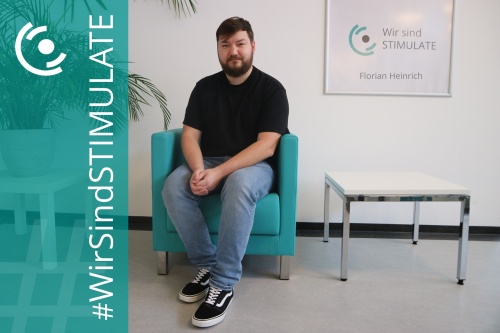
Interview ‘We are STIMULATE’ with Dr Florian Heinrich
Interviewee: Dr Florian Heinrich
Position: Senior Research Scientist
Interviewer: René Schulte
Date: 04.03.2026
Hello Florian, thank you very much for taking the time today to talk to us about your work at STIMULATE. We’re looking forward to finding out more about how effective human-machine interaction is designed and what role XR plays in this.
You lead the Human-Machine Interaction research group at the Research Campus: What are your key research questions, and how can one recognise ‘good’ human-machine interaction in medicine?
Reply: As a research group, we focus on various topics at the intersection of medicine, computer science and human-computer interaction – that is, human-machine interaction in the medical field. Our central question is essentially: “How can we improve usability and the user experience for specific medical applications in such a way that users are supported as effectively as possible?” The aim is always to improve usability for users: systems should feel intuitive, be easy to use and thus facilitate their transfer into clinical practice. Good usability also increases acceptance – nobody likes working with a system that is complicated to use.
Ultimately, good human-machine interaction is recognised precisely by this high level of usability. We therefore systematically test our prototypes in usability studies, work with various measurement tools, gather structured feedback and, if necessary, enter new iteration cycles. We can only truly assess the quality of the interaction once we have tested it in practice together with the users.
If you had to explain ‘XR’ to someone who knows nothing about it in a single sentence: what exactly is it, and what are the common misconceptions?
Reply: XR stands for Extended Reality and, as I understand it, is an umbrella term covering the ‘mixed reality continuum’. In other words, it refers to technologies in which digital content merges with the real world or replaces it entirely, with the aim of making information more vivid, tangible and often more intuitive to use. It encompasses, amongst other things, Augmented Reality (AR), Virtual Reality (VR) and Mixed Reality (MR). This is precisely where many misunderstandings arise: in popular culture, AR and VR are often confused. Yet VR involves complete immersion in a virtual environment, whereas with AR, you can still see the real world and it is supplemented with digital information.
You spent some time conducting research at a Natural User Interaction Lab: what did you take away from that collaboration? Did you bring back any skills that you’re actually using today in the context of STIMULATE?
Reply: The aim of my visit to Prof. Francisco Ortega’s Natural User Interaction Lab at Colorado State University was to establish a research collaboration. I had the opportunity to represent the STIMULATE research campus there, present our work, and spend two weeks working directly with the lab staff on an internal STIMULATE project. The lab has extensive experience in the field of natural interactions – a topic that is also central to our work. Whilst we have specialised heavily in medical interactions, they work more broadly and in other application contexts. This enabled us to learn about approaches and techniques that we had not previously considered, and we are now examining to what extent they can be applied to our medical scenarios. Specifically, we are continuing to utilise this collaboration within the STIMULATE context: we are currently using insights from Professor Ortega and his team on natural interaction in a project to retrospectively optimise 3D models.
As well as conducting research, you teach students in areas such as XR. What motivated you to go into academic teaching? Are there any aspects that students often underestimate, and what advice would you give them?
Reply: What motivates me most of all is passing on the knowledge we are so privileged to acquire here and passing it on to the next generation. I also find the close link to research exciting: I really enjoy feeding the content we are currently developing directly back into teaching and supporting students on their journey.
I often see challenges in translating theory into practice. In teaching, we usually show successful end results – the effort behind them remains invisible. That’s why students often choose projects that are too broad in scope, and it’s only later that they realise the content cannot be fully explored within the planned timeframe. Another point is the specialist terminology in human-computer interaction; the content often seems intuitive, but terms and concepts are important – particularly for exams and for one’s own understanding. You don’t need to know everything by heart, but you do need to know what to look for. My tip: consciously collect, organise and actively use terminology.
If you look three years ahead: Which XR application in medicine do you think will be the next to make the leap into everyday clinical practice – and why?
Reply: An exciting but difficult question. I don’t think we’ll be seeing augmented reality used routinely in the operating theatre within three years. Current headsets are still too heavy and uncomfortable, and there are still a number of regulatory hurdles to overcome, even though the first applications are already available today.
I see the next realistic step in medical training: virtual reality enables immersive 3D visualisations that allow procedures and anatomy to be understood much better than through textbooks alone. As the devices are also becoming increasingly affordable, I consider it very likely that XR applications will have become much more established in everyday medical training here within three years.
Thank you very much, Florian, for sharing your insights into research, teaching and XR – we look forward to seeing how your developments will be reflected in training and clinical practice over the coming years!
Click here for an overview of all interviews conducted so far.
Interview „Wir sind STIMULATE“ mit Dr. Florian Heinrich
Interviewter: Dr. Florian Heinrich
Stelle: Leitender wissenschaftlicher Mitarbeiter
Interviewer: René Schulte
Datum: 04.03.2026
Hallo Florian, vielen Dank, dass du dir heute die Zeit nimmst, mit uns über deine Arbeit bei STIMULATE zu sprechen. Wir freuen uns darauf, mehr darüber zu erfahren, wie gute Mensch-Maschine-Interaktion gestaltet wird und welche Rolle XR dabei spielt.
Du leitest am Forschungscampus die Forschungsgruppe Human-Machine Interaction: Was sind eure Kernfragen und woran erkennt man „gute“ Mensch-Maschine-Interaktion in der Medizin?
Antwort: Als Forschungsgruppe beschäftigen wir uns mit verschiedenen Themen an der Schnittstelle von Medizin, Informatik und Human-Computer Interaction, also der Mensch-Maschine-Interaktion in der Medizin. Unsere zentrale Kernfrage lautet im Grunde: „Wie können wir für spezifische medizinische Anwendungen die Usability (Gebrauchstauglichkeit) und die User Experience (Nutzungserlebnis) so verbessern, dass Anwender:innen optimal unterstützt werden?“ Ziel ist dabei immer, die Anwendbarkeit für die Nutzenden zu verbessern: Systeme sollen sich natürlich anfühlen, gut bedienbar sein und so den Transfer in die klinische Praxis erleichtern. Gute Usability steigert auch die Akzeptanz – niemand arbeitet gerne mit einem System, das kompliziert zu bedienen ist.
Gute Mensch-Maschine-Interaktion erkennt man am Ende an genau dieser guten Gebrauchstauglichkeit. Wir testen unsere Prototypen daher systematisch in Usability-Studien, arbeiten mit unterschiedlichen Messinstrumenten, holen strukturiertes Feedback ein und gehen, wenn nötig, noch einmal in neue Iterationsschleifen. Wirklich beurteilen können wir die Qualität der Interaktion erst dann, wenn wir sie gemeinsam mit den Nutzenden in der Anwendung erprobt haben.
Wenn du einem unwissenden Menschen „XR“ in einem Satz erklären müsstest: Was genau ist es und was sind typische Missverständnisse?
Antwort: XR steht für Extended Reality und ist in meinem Verständnis ein Dachbegriff entlang des „Mixed-Reality-Kontinuums“. Also für Technologien, bei denen digitale Inhalte mit der echten Welt verschmelzen oder diese vollständig ersetzen, mit dem Ziel, Informationen anschaulicher, erfahrbarer und oft auch intuitiver nutzbar zu machen. Er umfasst unter anderem Augmented Reality (AR), Virtual Reality (VR) und Mixed Reality (MR). Genau hier entstehen viele Missverständnisse: In der Popkultur werden AR und VR oft durcheinandergebracht. Dabei ist VR das vollständige Eintauchen in eine virtuelle Umgebung, während man bei AR die reale Welt weiterhin sieht und sie um digitale Informationen ergänzt.
Du warst zu einem Forschungsaufenthalt in einem Natural User Interaction Lab: Was hast du aus dieser Zusammenarbeit mitgenommen? Hast du Kompetenzen mitgebracht, die du heute im STIMULATE-Kontext konkret nutzt?
Antwort: Ziel des Aufenthalts im Natural User Interaction Lab von Prof. Francisco Ortega an der Colorado State University war es, eine Forschungskollaboration aufzubauen. Ich durfte dort den Forschungscampus STIMULATE vertreten, unsere Arbeit vorstellen und zwei Wochen lang direkt mit den Mitarbeitenden im Labor an einem internen STIMULATE-Projekt arbeiten. Das Lab ist sehr erfahren im Bereich natürlicher Interaktionen – ein Thema, das auch für uns zentral ist. Während wir uns stark auf medizinische Interaktionen spezialisiert haben, arbeiten sie breiter und in anderen Anwendungskontexten. Dadurch konnten wir Ansätze und Techniken kennenlernen, die wir bisher noch nicht im Blick hatten und nun prüfen, inwiefern sie sich auf unsere medizinischen Szenarien übertragen lassen. Konkret nutzen wir diese Zusammenarbeit heute im STIMULATE-Kontext weiter: Aktuell nutzen wir in einem Projekt Erkenntnisse von Professor Ortega und seinem Team zur natürlichen Interaktion, um 3D-Modelle nachträglich zu optimieren.
Neben der Forschung unterrichtest du Studierende unter anderem in XR. Was hat dich motiviert, in die akademische Lehre zu gehen? Gibt es Punkte, die von Studierenden oft unterschätzt werden und was würdest du Ihnen als Tipp mitgeben?
Antwort: Mich motiviert vor allem, das Wissen, das wir hier als großes Privileg vermittelt bekommen, weiterzugeben und an die nächste Generation zu tragen. Spannend ist für mich auch die Nähe zur Forschung: Inhalte, die wir aktuell entwickeln, direkt in die Lehre zurückzuspielen und Studierende auf ihrem Weg zu begleiten, macht mir große Freude.
Herausforderungen sehe ich oft bei der Übertragung von Theorie in Praxis. In der Lehre zeigen wir meist erfolgreiche Endergebnisse – der Aufwand dahinter bleibt unsichtbar. Deshalb wird der inhaltliche Projektumfang von Studierenden häufig zu groß gewählt und man merkt erst spät, dass die Inhalte in der geplanten Zeit nicht vollständig erforschbar sind. Ein weiterer Punkt ist die Fachterminologie in Mensch-Maschine-Interaktion; die Inhalte wirken oft intuitiv, aber Begriffe und Konzepte sind wichtig – gerade für Prüfungen und für die eigene Orientierung. Man muss nicht alles auswendig können, aber wissen, wonach man suchen muss. Mein Tipp: Begrifflichkeiten bewusst sammeln, einordnen und aktiv verwenden können.
Wenn du 3 Jahre nach vorn schaust: Welche XR-Anwendung in der Medizin wird deiner Meinung nach als nächstes den Sprung in den klinischen Alltag schaffen – und warum?
Antwort: Eine spannende, aber schwierige Frage. Ich glaube nicht, dass wir in drei Jahren schon routinemäßig Augmented Reality im OP sehen werden. Dafür sind aktuelle Brillen noch zu schwer, zu unbequem und es stehen noch einige regulatorische Hürden im Weg, auch wenn es heute schon erste Anwendungen gibt.
Den nächsten realistischen Schritt sehe ich in der medizinischen Ausbildung: Virtual Reality erlaubt immersive 3D-Darstellungen, mit denen sich Abläufe und Anatomie deutlich besser verstehen lassen als nur über Lehrbücher. Da die Geräte gleichzeitig immer günstiger werden, halte ich es für sehr wahrscheinlich, dass XR-Anwendungen hier in drei Jahren deutlich stärker in der alltäglichen medizinischen Ausbildung angekommen sind.
Vielen Dank, Florian, für deine Einblicke in Forschung, Lehre und XR – wir sind gespannt, wie sich eure Entwicklungen in den nächsten Jahren in Ausbildung und Klinik wiederfinden werden!
Hier geht's zur Übersicht über alle bisher geführten Interviews.